Is Ozempic Made From Lizard Venom? Not Exactly

Ozempic is not squeezed out of a lizard. But the whole drug class exists because of one. The real story of the Gila monster's gift.
Part of the Health and wellbeing collection.
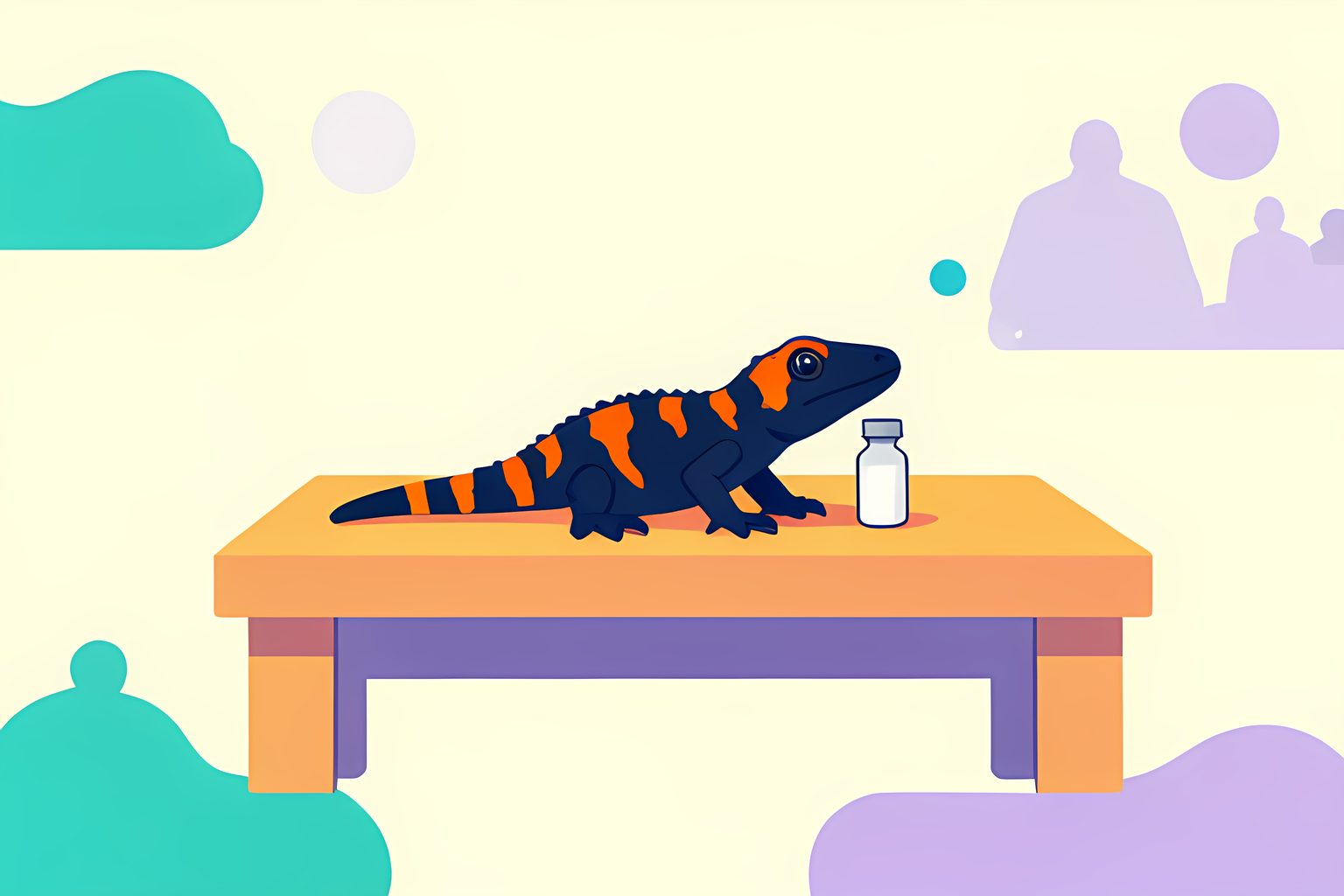
The Gila monster eats about twice a year. The slow, black-and-orange lizard of the American Southwest survives its long fasts by keeping its blood sugar rock steady, a trick that caught the attention of one very persistent doctor in the Bronx.
That doctor was John Eng, an endocrinologist at the James J. Peters VA Medical Center. In the early 1990s he ordered a vial of dried Gila monster venom from a serpentarium in Utah and went looking for whatever let the animal hold a flat blood-sugar line for months.
He was not working alone. Jean-Pierre Raufman, a researcher who had studied lizard venom at the National Institutes of Health, drove regularly from Brooklyn to the Bronx with test tubes rattling around in his Toyota Camry. Together they pulled a single peptide out of the venom and named it exendin-4.
What they had found was a natural mimic of GLP-1, the hormone your gut releases after eating to call for insulin. The human version breaks down in about two minutes, far too fast to be a useful drug. The lizard's version lasted for hours. Same signal, far better battery life.
So is Ozempic made from lizard venom?
Not literally, no. Semaglutide, the molecule in Ozempic and Wegovy, is designed and built in a laboratory. It is modeled on human GLP-1, and no lizard is milked to make it. What the Gila monster contributed was the proof of concept, the idea that a long-lived GLP-1 mimic could work as a medicine. Without the lizard, the whole drug class almost certainly never gets built.
The patent the VA said no to
Here is the part that still stings a little. Eng asked the Department of Veterans Affairs to patent exendin-4, and the agency declined. So he filed the patent himself and licensed it to Amylin Pharmaceuticals. Amylin turned it into exenatide, sold as Byetta, which the FDA approved in 2005 as the first GLP-1 drug for type 2 diabetes.
One former Amylin research executive later called Byetta the most effective diabetes drug anyone had ever seen. From there the industry spent two decades refining the idea into longer-lasting, once-weekly versions. Novo Nordisk's Ozempic arrived in 2017, and the higher-dose Wegovy for weight loss followed.
Byetta itself needed two injections a day and has since been retired, along with its long-acting cousin Bydureon, in 2024. The idea outlived the product. Every GLP-1 medicine sold today, from daily Rybelsus to weekly Ozempic, traces its ancestry to that first lizard peptide.
Why the lizard was worth a second look
Gila monsters were already famous for a different kind of bite. Their venom was known mostly as a painful novelty, not a pharmacy. The reason anyone thought to study it at all traces to Raufman's earlier work showing the venom stirred the pancreas in surprising ways. Somewhere in a creature built to barely eat, evolution had written a masterclass in blood-sugar control.
The part nobody predicted is the appetite. When Eng published, the goal was diabetes. It took years for researchers to realize the same hormone that controls blood sugar also quiets hunger, which is what turned the lizard's gift into a weight-loss phenomenon and made Ozempic a household word.
The lizard-to-medicine timeline
- 1992
- John Eng isolates exendin-4 from Gila monster venom
- 2005
- Exenatide (Byetta) becomes the first GLP-1 drug
- 2017
- Ozempic arrives
- 2021
- Wegovy, for weight loss, arrives
Eng worked under Rosalyn Yalow, the Nobel laureate who helped invent the radioimmunoassay techniques he used to find the molecule. Decades later the Golden Goose Award, which honors odd-sounding federal research that pays off, singled out his lizard for exactly that reason. A strange question, a cheap vial of venom, and a researcher too stubborn to drop it.
Sources
Every factual claim above traces to one of these. Links open in a new tab.