Why an Eclipse Season Makes Two Different Eclipses

A total solar eclipse and a partial lunar eclipse can arrive only two weeks apart without copying each other. The answer is a moving geometric window, not a cosmic change of heart.
Two weeks is an unusually short time to wait for the sky to change its costume. Yet August 2026 has supplied a total solar eclipse on August 12 and, only fifteen nights later, a deep partial lunar eclipse on August 27-28. That is not a coincidence, nor is it a pair of unrelated spectacles booked by an overenthusiastic universe.
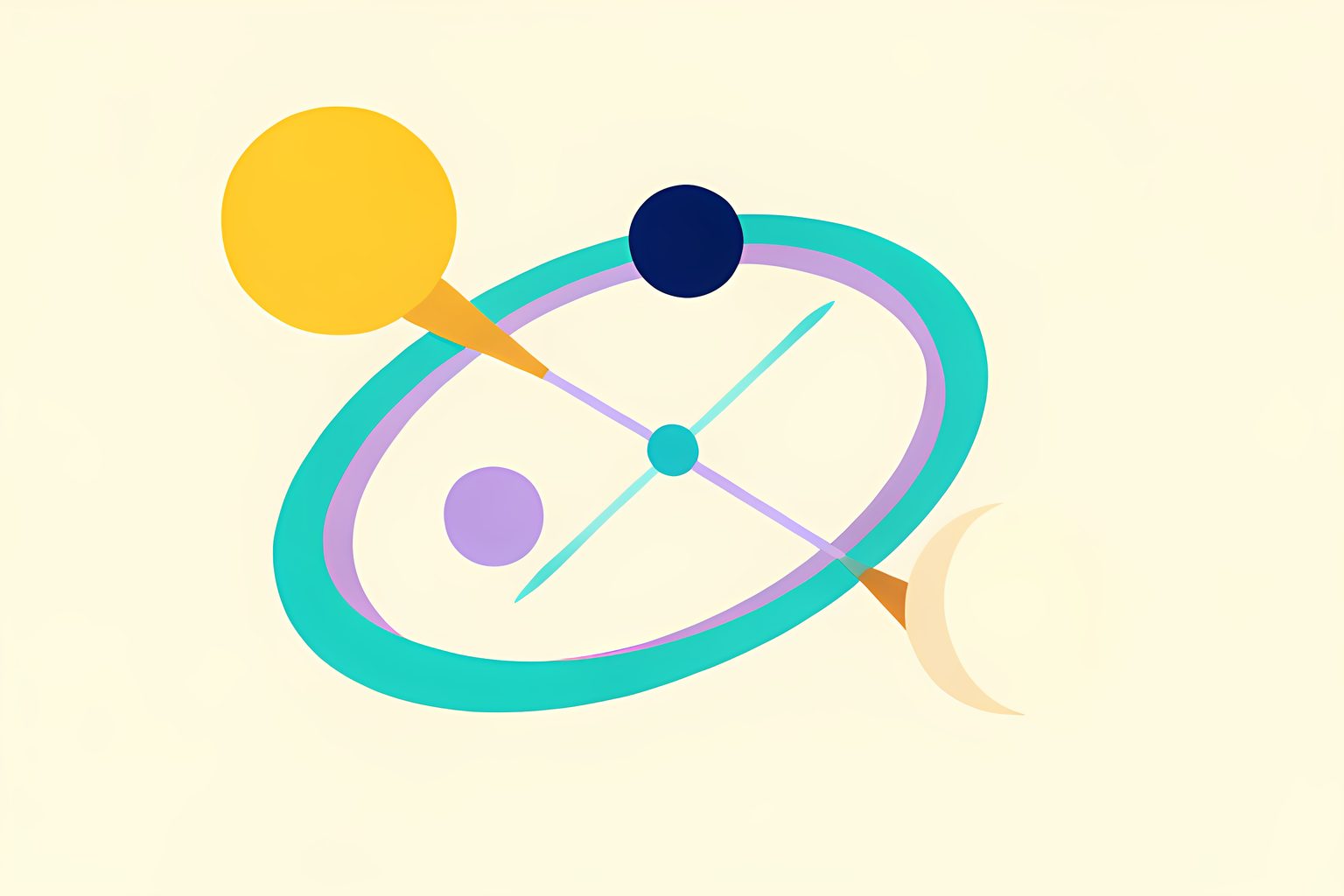
They belong to the same eclipse season: a short stretch in which the Sun, Earth, and Moon can line up closely enough for shadows to matter. The charming wrinkle is that the two events do not have to match. One can be total while its companion is partial. This season is an excellent example. NASA lists the August 12 event as total and the August 28 event as partial.
The timing in one glance
- August 12, 2026:
- A total solar eclipse occurred at New Moon.
- August 27-28, 2026:
- A deep partial lunar eclipse occurs at Full Moon.
- The shared reason:
- Both fall inside the same roughly month-long alignment window.
- The difference:
- Their alignments land at different points within that window.
The Moon's orbit is tilted, which saves us from monthly eclipses
At first blush, the calendar seems to promise too many eclipses. There is a New Moon and a Full Moon every month. A solar eclipse needs the Moon between Earth and the Sun at New Moon; a lunar eclipse needs Earth between the Sun and Moon at Full Moon. If all the orbits lay in one perfectly flat plane, we would get both on a clockwork monthly schedule. We do not, because the Moon's orbital path is tilted by about five degrees relative to Earth's path around the Sun. NASA JPL says most Full Moons therefore pass above or below Earth's shadow.
The tilted path crosses the larger orbital plane at two places called nodes. Think of them as two invisible crossings on a very large track. When the Sun is near one of those crossings, the geometry opens for a while. The European Space Agency puts that opportunity at about 35 days around each node. Then the window closes again, and ordinary New and Full Moons resume their perfectly respectable, shadow-free business.
Why the pair is often about two weeks apart
The Moon takes about 29.5 days to go from one New Moon to the next, with Full Moon roughly halfway through. That means a New Moon that falls inside an eclipse season is often followed around two weeks later by a Full Moon that is still inside the same window. One alignment makes a solar eclipse. The other can make a lunar eclipse. Timeanddate's eclipse-season guide notes that each season is long enough to guarantee, somewhere on Earth, one solar and one lunar eclipse.
That is the pairing. It is less a matched set than a two-act play in which the cast changes position between scenes. At New Moon, the Moon is on the Sun-facing side of Earth. At Full Moon, it is on the opposite side. The shadow-maker changes from the Moon to Earth, and the place from which people can watch changes with it.
Why one act can be total and the other partial
The middle of an eclipse season is the best place for an exact three-body lineup. At the edges, the Moon can still be close enough to make an eclipse, but not centered enough for the fullest version. Timeanddate describes the result plainly: a New or Full Moon near the middle can yield a total event, while one closer to the beginning or end can yield a partial event, or a faint penumbral lunar one. The seasonal window permits eclipses; it does not promise that every eclipse inside it will have identical geometry.
That is why August's pair makes sense. The solar alignment on August 12 was exact enough to create totality along a narrow path. By the time the Moon reached Full Moon about fifteen days later, the lineup was still excellent but slightly off-center. NASA's August lunar-eclipse visualization shows 96.3% of the Moon's area entering Earth's umbra, a spectacularly deep pass that remains technically partial because a small portion stays outside.
A pair does not mean a shared viewing map
This is the practical detail worth keeping. A total solar eclipse is a narrow-path event because the Moon's central shadow is small when it reaches Earth. A lunar eclipse is visible much more broadly because viewers are standing on the world that casts the shadow. NASA says each lunar eclipse is visible from roughly half of Earth, weather and local horizon permitting. The two events can be siblings in the same season yet feel completely different from your backyard.
- For a solar eclipse, location decides whether totality is even possible.
- For a lunar eclipse, the first question is simpler: is the Moon above your horizon while the event is happening?
- For either one, clouds retain their traditional right of final refusal.
The cheerful part of the pattern
There is something reassuring about a sky event that looks rare but is not random. The Moon's nodes drift slowly, so eclipse seasons recur just under six months apart. NASA's eclipse-periodicity material gives 173.3 days between their midpoints. The clock is elaborate, but it is a clock.
So the next time two eclipses crowd the calendar, treat the pair as a clue. The sky has found one of its narrow alignment windows, and the Moon is using both its monthly phases before the window slides away. For the curved shadow itself, read why a lunar eclipse takes a round bite from the Moon.
Sources
Every factual claim above traces to one of these. Links open in a new tab.