A Tactical Guide to Leylah Fernandez's Early-Strike Tennis

By standing inside the baseline and striking the ball on the rise, Leylah Fernandez turns opponent pace into sharp left-handed angles.
Stand near the court fence during a professional tennis match, and you will notice that most baseline counter-punchers back up five to ten feet behind the baseline against heavy hitters. They retreat to buy precious milliseconds of reaction time. Leylah Fernandez does the exact opposite. She steps directly onto the baseline, plants her sneakers, and strikes incoming balls as they rise off the hard court.
When we break down tennis mechanics at Joyful Take, we look for how strategy overcomes raw physical force. I analyzed Fernandez's match footage to see why her southpaw court craft presents such a difficult puzzle for conventional power hitters. Her game is a masterclass in geometry, kinetic redirection, and economy of movement.
The Physics of Taking the Ball on the Rise
Hitting on the rise means contacting the tennis ball during the ascending phase of its bounce, before it reaches its peak. It requires total commitment. There is no hesitation allowed.
Most players let the ball bounce, reach its zenith, and begin dropping into their comfortable strike zone around waist height. That retreat creates safety, but it gives away court position. Fernandez sacrifices safety for tempo.
- Time Robbery: Intercepting the ball three feet earlier steals approximately 0.4 seconds from the opponent's recovery window. That forces opponents into rushed, defensive strokes.
- Kinetic Rebound: Hitting on the rise allows a player to repurpose the incoming shot's forward energy. Fernandez does not need to generate 80 mph of independent racket-head speed when she can redirect incoming 80-mph pace.
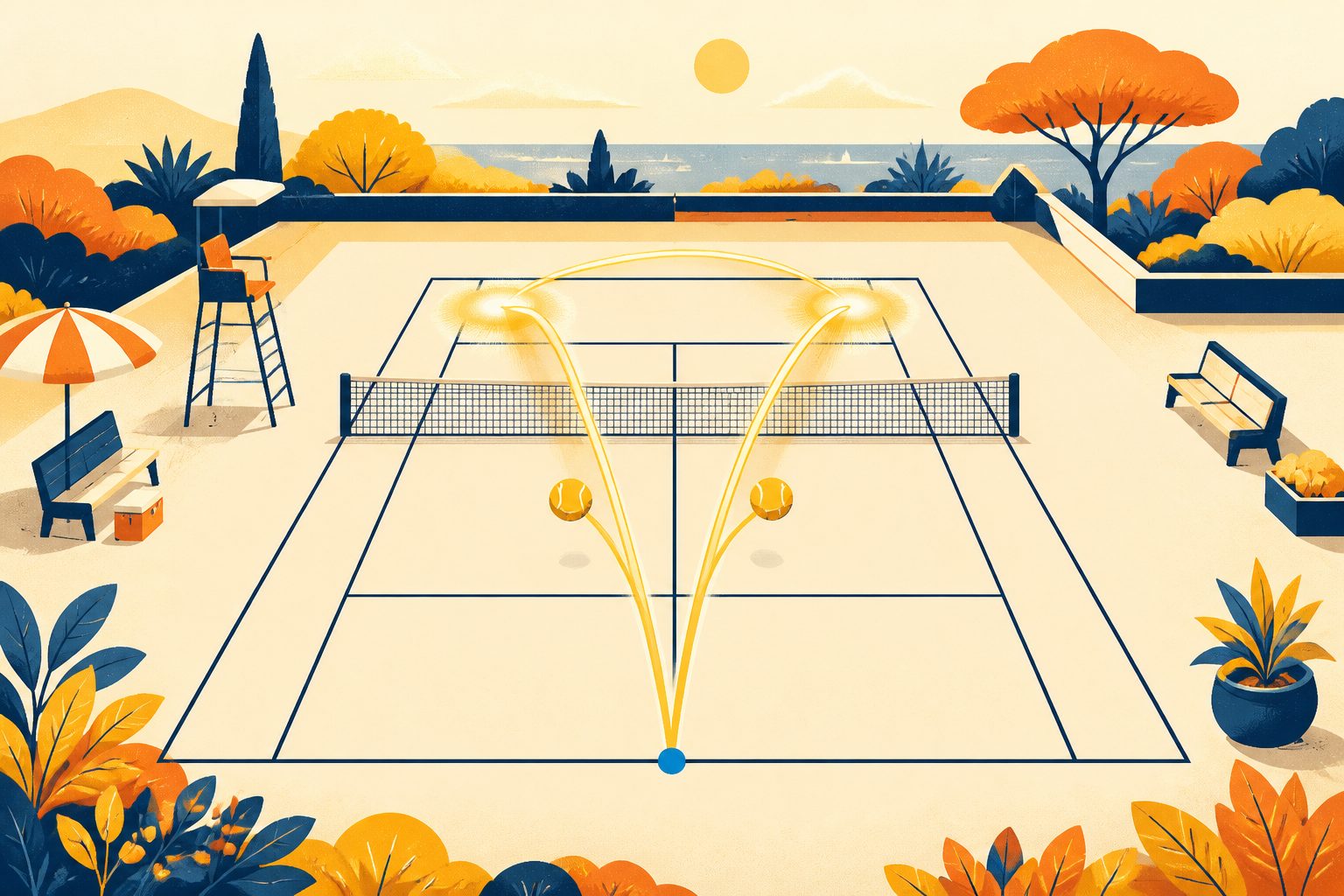
- Geometric Leverage: Striking closer to the net widens the available target area. From the baseline, the cross-court angle reaches the doubles sideline; from ten feet back, that same shot angle flies out of bounds.
The Compact Unit-Turn Forehand
Big baseline swings require time. When an opponent hammers a flat shot deep into the corner, a player with a long, looping take-back gets jammed. Fernandez avoids this trap through a compact unit turn.
Instead of drawing her racket back in a wide circle with her arm alone, she coils her entire upper torso as one connected unit. Her left elbow stays tucked near her ribcage. Her racket head never drifts far behind her back hip. That compact motion keeps her swing fast and repeatable under extreme pressure.
This short backswing provides extraordinary stability under heavy pressure. She can make contact out in front of her lead knee even when rushed. From that stable platform, she flicks her wrist to create dipping topspin cross-court or flattens out her swing for a clean down-the-line winner.
Return Positioning and Baseline Pressure
Fernandez's aggressive mindset is especially evident on return of serve. On second serves, she often stands a foot inside the baseline. She attacks kick serves before they can jump above her shoulder height, eliminating the server's primary weapon. By taking the ball at waist level on the rise, she immediately seizes control of the point.
Against flatter first serves, she shortens her split-step and uses a punch-block return. The ball rebounds deep into the server's feet before the server can complete their follow-through. This relentless forward pressure turns defensive moments into instant offensive opportunities.
The Southpaw Serve and Net Craft
Being left-handed provides a natural structural edge in tennis. Fernandez uses her southpaw slice serve to target the ad court, curving the ball away from right-handed players' backhands. That single shot drags the returner several feet outside the doubles alley, exposing the entire deuce side for an uncontested serve-plus-one forehand.
Her doubles achievements have added another crucial layer to her singles arsenal. Reaching the 2023 French Open doubles final with Taylor Townsend sharpened her forward movement, reflex volleys, and overhead put-aways. She does not remain trapped at the baseline. When an opponent sends back a floating, off-balance reply, Fernandez steps forward and closes out the point at the net with soft hands.
Our takeaway from studying Fernandez is that court position is an active decision. By stepping forward and claiming the baseline, she proves that early timing and clean angles remain the ultimate equalizer against raw power.
Sources
Every factual claim above traces to one of these. Links open in a new tab.
- Leylah Fernandez | Player Profile and Match Statistics
- Tactical Analysis of Taking the Ball on the Rise in Tennis
- Leylah Fernandez and Taylor Townsend reach 2023 French Open doubles final
- The Left-Handed Tennis Advantage and Court Geometry
- Leylah Fernandez on tactical coaching with Eric Hechtman and Jorge Fernandez