Before Yachts Drop Anchor Mallorca Guards Ancient Seagrass

Before superyachts drop heavy iron in Balearic coves, patrol boats and VHF Channel 68 steer crews away from 100,000-year-old Posidonia meadows.
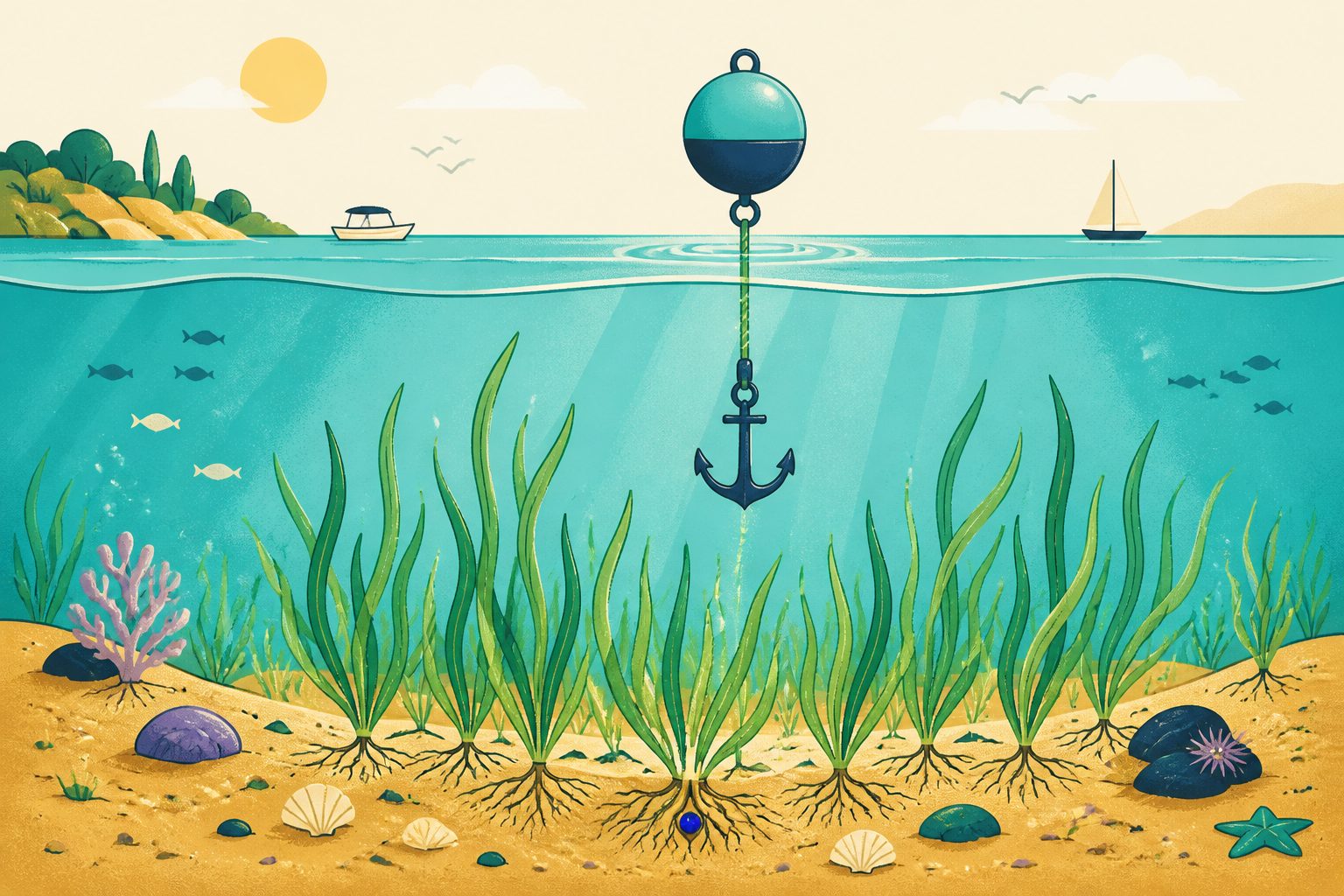
When luxury superyachts cruise into Mallorca's turquoise coves, most onlookers focus on the famous passengers standing on the sun decks. I find the quiet defensive operation taking place directly beneath the waterline far more remarkable. Before a captain drops a multi-ton steel anchor into a Balearic bay, their bridge crew must navigate one of the strictest and most technologically coordinated marine conservation networks in southern Europe. We often take pristine holiday waters for granted, but Mallorca's clarity is the result of continuous, deliberate protection.
The coastal waters of Mallorca, Menorca, Ibiza, and Formentera owe their startling aquamarine clarity to Posidonia oceanica, an endemic Mediterranean marine plant. Posidonia is not simple seaweed. It is a flowering seagrass that produces extensive underwater meadows, filtering suspended sediment, stabilizing shorelines against winter storms, and oxygenating coastal shallows. It forms a thriving aquatic jungle that shelters hundreds of species of fish, seahorses, and crustaceans.
The 100,000-Year-Old Underwater Forest
Genetic researchers have discovered that these continuous meadows are among the oldest living clonal organisms on the planet. Individual beds in the Balearic seabed date back roughly 100,000 years. They grow at an exceptionally slow rate of only a few centimeters per year. In addition to harboring biodiversity, Posidonia meadows absorb fifteen times more carbon dioxide per square meter than tropical rainforests, serving as vital global carbon sinks. When a fifty-meter superyacht drops a heavy claw anchor and lets its chain drag across the seabed, it can tear through centuries of delicate botanical growth in a few seconds. The damage takes generations to heal.
I looked into the historical damage that prompted local action. By the mid-2010s, surging mega-yacht traffic along the Mallorca and Formentera coastlines was leaving deep scars across the sea floor. Without intervention, the islands risked losing the very ecological engine that produced their postcard-perfect waters. In response, marine scientists and regional authorities developed a comprehensive digital mapping system known as Atlas Posidonia, combining satellite imagery, acoustic sonar sounding, and drone surveillance to chart every meadow in high definition.
Decree 25/2018 and the VHF Channel 68 Patrols
To prevent irreversible habitat loss, the regional government of the Balearic Islands approved Decree 25/2018. This landmark legislation completely prohibits anchoring on Posidonia meadows across the entire archipelago. To enforce compliance, authorities established severe administrative penalties, with fines scaling up to 450,000 euros for catastrophic damage caused by commercial vessels and mega-yachts.
We investigated how the surveillance protocol operates during the peak summer sailing season. The regional environmental agency deploys the Servicio de Vigilancia de la Posidonia, a dedicated fleet of twenty patrol boats operating from dawn until dusk. Captains of vessels exceeding fifteen meters in length are encouraged to contact the surveillance team directly on VHF Channel 68 before approaching an anchorage. Patrol officers provide immediate GPS guidance, directing vessels to verified sandy patches where anchors can hold securely without touching seagrass.
- Captains consult the official Atlas Posidonia digital cartography before entering coastal bays
- Bridge crews contact patrol boats on VHF Channel 68 for verified sand-bed coordinates
- Over 250 low-impact eco-buoys provide secure moorings without seabed dragging
- Surveillance skiffs conduct daily visual inspections of anchor chains across all major calas
A Cooperative Model for Mediterranean Tourism
What makes the Balearic approach genuinely joyful is its emphasis on cooperative stewardship rather than punitive confrontation. Patrol officers act as maritime ambassadors, distributing educational charts and helping international crews anchor safely. When visiting captains learn that the seagrass beneath their hulls predates human civilization, they gladly adjust their anchor lines. Special eco-buoys with helical screw anchors allow vessels to tie up without dragging chains across the sea floor. This mutual respect ensures that luxury yachts and ancient prehistoric seagrass meadows share the same luminous bays in enduring balance.
Sources
Every factual claim above traces to one of these. Links open in a new tab.
- Regulations and Legal Framework for Posidonia Protection: Decree 25/2018
- Balearic Marine Cluster: Superyacht Guide to Posidonia Conservation
- Anchoring Regulations and Protected Meadows in the Balearics
- Balearic Posidonia Patrols Assist Thousands of Boats Every Summer
- Environmental Maritime Rules for Chartering and Anchoring in Mallorca