Clay Spin vs Grass Slice in Alejandro Tabilo Match Tactics

Comparing how Alejandro Tabilo adjusts his left-handed topspin, low slice, and baseline court positioning across clay and grass.
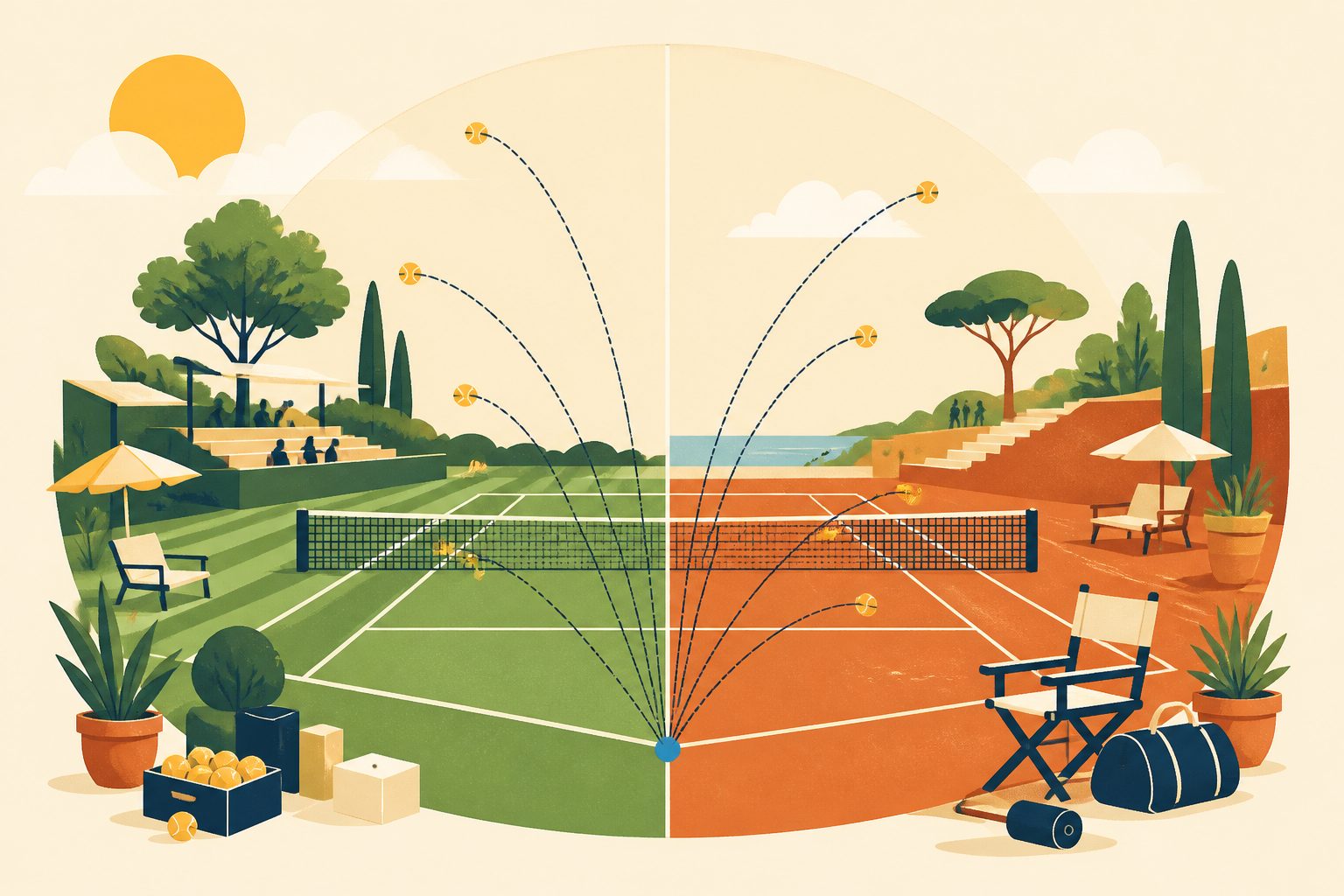
When I watched the tape of Alejandro Tabilo's title run at the 2024 Mallorca Championships, the contrast with his semifinal run on Rome's red dirt two months earlier was striking. Tennis history is filled with players whose games thrive on slow dirt but fall apart on slick turf. For decades, South American champions built their careers around heavy topspin loops that bounce high and slow down. Natural grass does the opposite. The surface rewards low posture, flat trajectories, and lightning-fast reflexes.
Tabilo succeeded where many predecessors struggled because he does not force a single tactical blueprint onto different conditions. By breaking down his match patterns across surfaces, we can see how the Chilean left-hander calibrates his shot selection, spin rates, and court positioning between clay and grass.
Heavy topspin and patient geometry on red clay
On red clay, Tabilo relies on heavy rotational spin. Standing roughly four to six feet behind the baseline, he uses a full Western-leaning forehand grip to brush up the back of the ball. This produces heavy topspin revolutions that bite into the dirt and kick sharply upward. Against right-handed opponents, this creates an unrelenting diagonal assault on their backhand wing.
Clay allows him time to set his feet. Because the red dirt absorbs ball velocity, rallies average between six and ten shots. Tabilo uses this extended cadence to construct points methodically. He pins opponents deep behind their baseline with looping depth before changing direction with an inside-out forehand drive into the open deuce court.
The clay also magnifies the threat of his drop shot. When opponents retreat behind the baseline to handle his high-kicking spin, Tabilo disguises a soft backspin drop that dies in the clay dust. During his 2024 Rome run, this combination completely disrupted baseline rhythm, allowing him to dominate longer exchanges with minimal unforced errors.
His return position on clay is similarly deep. Taking returns several paces behind the baseline gives him the required arc to neutralize booming first serves, resetting rallies into neutral territorial struggles where his sliding agility shines.
Low skidding slice and forward positioning on grass
On grass courts, heavy looping topspin is a liability because high bounces sit up comfortably for aggressive hitters. In Mallorca, Tabilo adapted his mechanics immediately. He moved his baseline positioning two steps forward, hugging the baseline to take balls on the rise before they lost momentum.
His primary weapon on turf shifted from looping topspin to a biting, low-skidding backhand slice. On grass, the slice stays below knee height, forcing tall opponents like Sebastian Ofner to bend low and hit upward. Tabilo followed these skidding slices directly to the net, finishing points with crisp reflex volleys.
His serve dynamics changed just as dramatically. On clay, he uses high kick serves to push returners off balance. On grass, he flattened out his delivery and leaned into his left-handed slice serve, dragging returners far outside the doubles alley on the ad side. The ball skids off the grass blades and slides away, producing easy aces and unreturnable serves.
Footwork on grass requires shorter, choppy steps rather than long clay slides. Tabilo stays exceptionally low in his stance, maintaining knee bend through contact to ensure his contact point never rises above waist level.
A tactical balance that bridges two tennis worlds
The foundation for this dual-surface mastery traces back to his hybrid upbringing. Growing up on indoor hard courts in Toronto gave him compact swing timing and quick hand speed. Moving to Santiago as a young professional gave him the patience, sliding footwork, and tactical endurance required for clay.
What I admire about Tabilo's tactical evolution is his willingness to embrace nuance. Rather than being confined by traditional South American clay dogmas, he treats each surface as a distinct canvas. Becoming the first Chilean man in the Open Era to win an ATP grass title was not an accident of the draw; it was the direct reward for an adaptable, curious tennis mind.
Sources
Every factual claim above traces to one of these. Links open in a new tab.