Singles endurance vs doubles reaction time in modern tennis

Comparing the baseline running distances of singles with the rapid-fire net reflexes and angled court geometry demanded in championship doubles.
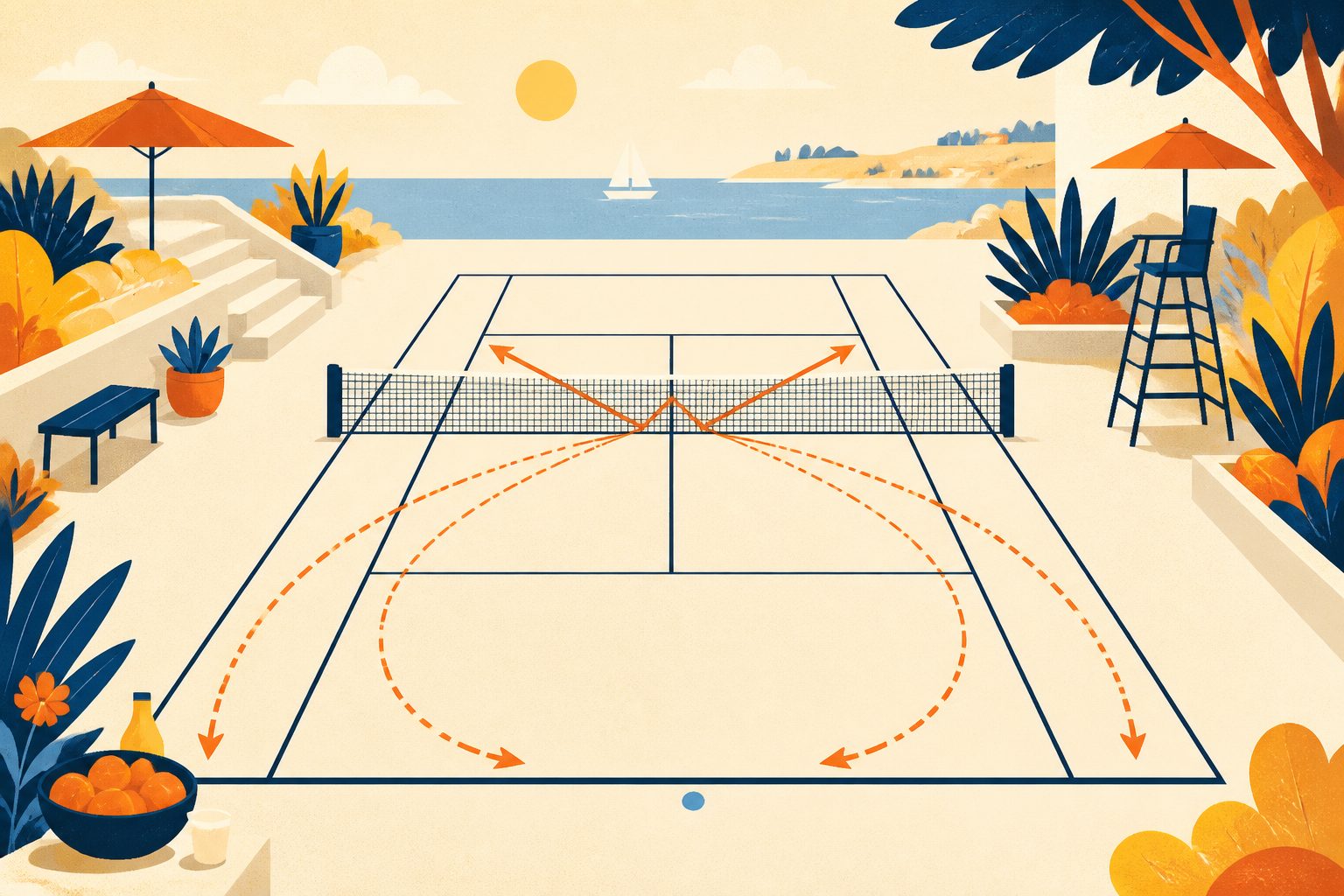
When I watch an elite competitor step off a grueling two-hour singles match and return to the court two hours later for doubles, the contrast in physiological and mental stress is immediate. It looks nearly impossible. The two events share a net, racquets, and standard yellow felt balls, but they test entirely separate athletic engines under competitive summer heat.
We often treat tennis as a single continuous skill in mainstream sports commentary. That assumption is deeply flawed. In reality, the split between singles distance endurance and doubles reaction time demands two completely different tactical mindsets, neuromuscular responses, and physical conditioning regimens.
Baseline mileage vs explosive net reflex
In a three-set singles match, an elite professional routinely covers between two and three miles of intense, multi-directional movement across the baseline. Most of that distance consists of punishing lateral sprints, deep recovery lunges, and rapid decelerations designed to reset footwork behind the center mark. Legs burn constantly. The aerobic and anaerobic demands require immense cardiovascular fitness and sustained muscular stamina through long rally exchanges that often stretch past twenty shots.
Doubles sharply reduces that overall running distance to roughly one-third of a singles contest. Total mileage drops dramatically. However, doubles replaces prolonged aerobic running with explosive, short-burst reactivity where split seconds decide entire championships. Net exchanges occur at distances of fifteen feet or less, where ball flight times shrink below four hundred milliseconds. A player must process visual cues instantly, shift balance, and execute a compact punch volley with pinpoint precision.
The cognitive load at the net is ferocious. While a baseliner has roughly one and a half seconds to track the ball's bounce and set up their swing, a doubles net player operates on pure instinct. You do not have time to think about mechanics. You read the angle of the opponent's racquet face before contact, commit to a direction, and trust your reflexes to absorb a hundred-mile-per-hour drive.
Alley width and geometric passing channels
Court geometry completely reshapes shot selection and tactical intention between the two formats. In singles, the court measures exactly 27 feet wide. A player defends that territory alone, aiming deep crosscourt drives to push the opponent backward. Open space is created through patience, rally depth, and sudden changes of direction down the line.
The doubles court widens to 36 feet by incorporating the 4.5-foot tramlines on each sideline. With two skilled opponents defending the space, baseline hitting lanes shrink into microscopic passing corridors. Angles dictate everything. Serving and returning emphasize dipping topspin balls directly at the server's feet or carving sharp angled volleys through the vacant center seam. Any ball that floats waist-high above the net tape gets punished by an alert poaching partner. Space vanishes in a flash.
This geometric squeeze alters the psychology of serving. In singles, an ace down the tee is a clean point winner. In doubles, a slightly misplaced serve gives the receiver an open angle to hit directly at the net player, flipping offense into defense in the blink of an eye.
Managing recovery across Grand Slam fortnights
The hardest challenge of competing in both events is managing physical recovery during high-stakes Grand Slam tournaments. Tour scheduling can force a dual-discipline competitor onto stadium courts for consecutive matches on sweltering afternoons. Rest is brief. Lactic acid buildup from an intense singles battle must be cleared quickly through active recovery, hydration, ice baths, and targeted massage before net reflexes are tested in doubles.
Yet when balanced with discipline, doubles play sharpens singles execution in measurable ways. Rapid net exchanges improve baseline return anticipation, sharpen reaction times on defensive lunges, and build confidence moving forward on short balls. I find that when an athlete strikes the right training harmony, the two disciplines feed each other beautifully, turning versatility into an undeniable competitive advantage.
We see this truth in players who embrace both draws with genuine joy and tactical commitment. The reward is a richer understanding of court geometry and a resilient body that fears no third-set tiebreak.
Sources
Every factual claim above traces to one of these. Links open in a new tab.