After a severe Midwest storm, power grids restore from backbone to tap

When straight-line winds bring down thousands of power lines, repair crews do not work street by street. They follow an engineered five-tier restoration hierarchy.
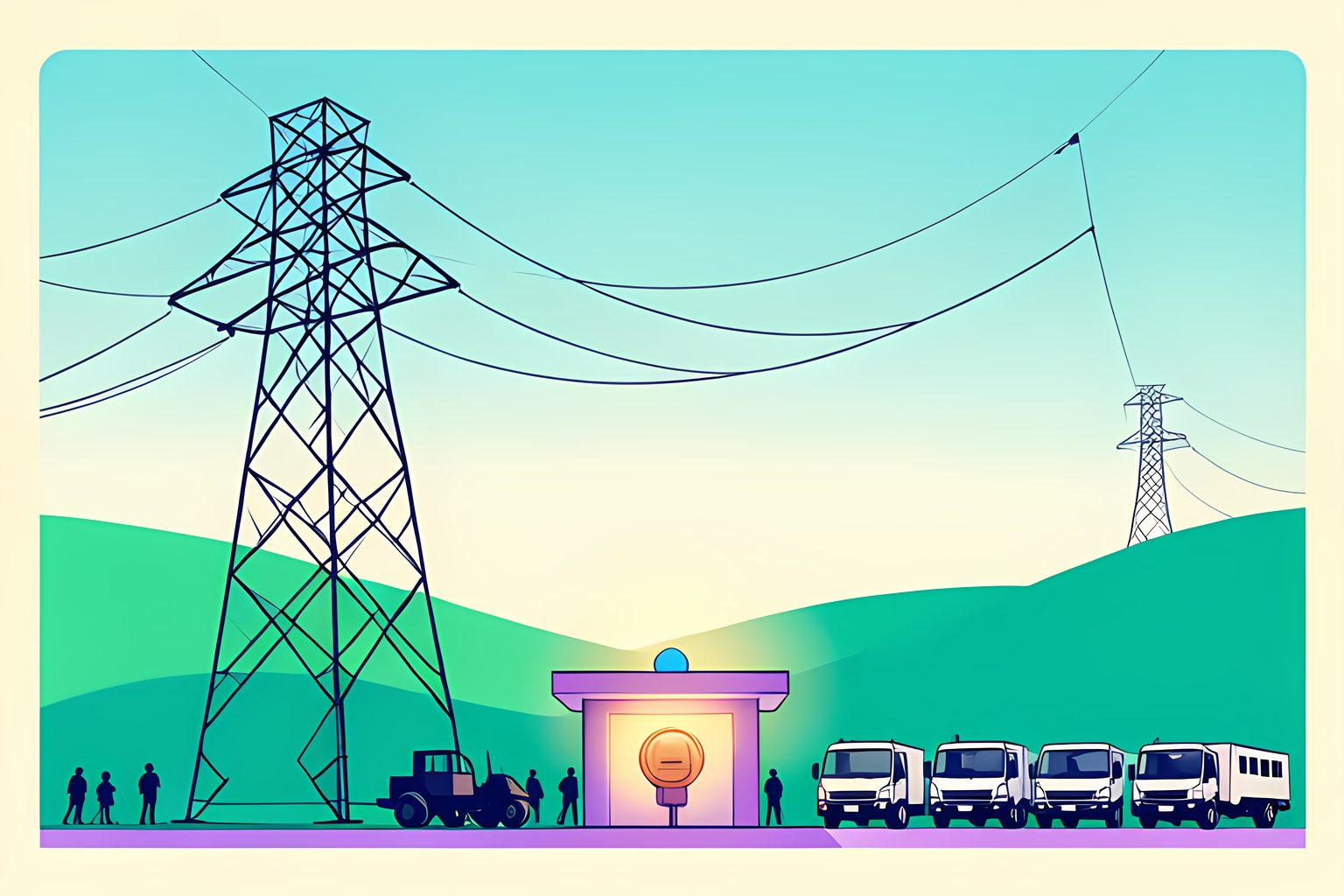
When I looked through regional power restoration logs following severe summer windstorms across the Midwest, one question kept surfacing from neighborhood message boards: why does the repair truck drive right past a dark street without stopping? When an intense squall line or derecho knocks out power to hundreds of thousands of homes, the natural human expectation is that utility crews will begin fixing the nearest fallen wire. What we actually discover upon examining grid operations is a strict, top-down engineering pyramid designed to bring the largest number of people back online safely.
An electric power grid cannot simply be turned back on with a single switch. Electricity is generated, stepped up to hundreds of thousands of volts for long-distance transport, stepped down at local substations, and finally divided across neighborhood distribution circuits. If the high-voltage transmission lines or substations upstream are damaged, energizing a neighborhood street is impossible because there is no incoming voltage to deliver. As we study the blueprints of modern regional grids, repairing storm damage resembles rebuilding a river basin from the main channel outward to the smallest creeks.
Tier 1: High-Voltage Transmission Lines and Power Plants
The foundation of the entire system sits at the bulk transmission level. High-voltage lines, carrying between 69,000 and 765,000 volts on towering steel lattice structures or heavy steel monopoles, transport bulk energy directly from generating stations to regional distribution centers. A single damaged transmission tower can leave entire counties without power, even if every local wooden pole on residential streets remains standing.
Utility dispatchers and grid operators prioritize these backbone corridors above all else. Lineworkers use heavy cranes, helicopters, and specialized tensioning rigs to re-string conductors and replace shattered ceramic insulators. Once bulk transmission capacity is restored, electricity flows freely into regional circuits, clearing the path for the next layer of the recovery sequence.
The 5-Tier Power Grid Restoration Hierarchy
- Tier 1: Transmission Lines
- 69 kV to 765 kV bulk supply carrying power across regions
- Tier 2: Substations
- Transformers step voltage down to 4 kV - 34.5 kV for local delivery
- Tier 3: Three-Phase Feeders
- Main distribution arteries serving thousands of customers and critical sites
- Tier 4: Tap Lines (Laterals)
- Single-phase neighborhood branches along residential avenues
- Tier 5: Service Drops
- Individual wires connecting pole transformers to private homes
Tier 2: Regional Substations and Critical Infrastructure
Substations act as the heavy mechanical gateways of the electric network. Here, massive oil-cooled transformers take the high-voltage transmission current and step it down to distribution voltages, typically between 4,000 and 34,500 volts. If floodwaters, lightning strikes, or wind-blown debris breach a substation fence, the diagnostic assessment must happen immediately.
Before energizing outbound lines, electrical engineers inspect circuit breakers, bus bars, and protective relays. In this second tier, grid managers also coordinate emergency feeds for life-safety infrastructure. Hospitals, emergency dispatch centers, water treatment facilities, and designated cooling shelters receive prioritized switching routes, frequently drawing from secondary backup feeds built into redundant ring topologies.
Tier 3: Main Distribution Feeders
Once substations are energized, utility crews turn their attention to main distribution lines, commonly known as feeders or trunk lines. These are the three-phase circuits mounted high on roadside utility poles, recognizable by their three distinct horizontal crossarm wires and heavy porcelain cutouts. A single three-phase feeder commonly supplies electricity to 1,000 to 3,000 customers, as well as essential commercial centers like grocery stores, pharmacies, and fuel stations.
Lineworkers systematically patrol the feeder route, clearing fallen oak branches, replacing splintered wooden crossarms, and pulling new aluminum conductors. They work methodically from the substation outward. When a feeder is repaired and tested, thousands of homes often flicker back on simultaneously, instantly cutting outage numbers across utility dashboard maps.
Tier 4: Tap Lines and Neighborhood Laterals
Branching off from main feeders are tap lines, often called lateral lines. These are the single-phase circuits that run down residential side streets, cul-de-sacs, and alleyways. Tap lines are protected by individual fused cutouts-small spring-loaded devices that drop open with a loud mechanical snap when a tree branch touches a wire, isolating the localized fault so the main feeder stays energized.
Repairs at this level restore electricity to groups of 10 to 50 homes at a time. Lineworkers use hydraulic bucket trucks to splice severed wires, replace blown fuse barrels, and trim entangled branches. This phase demands substantial crew coordination because thousands of individual lateral branches may be tangled in residential tree canopies across a single metropolitan area.
Tier 5: Individual Service Drops
The final stage of restoration addresses the service drop, the insulated triplex wire running from the neighborhood pole transformer directly to a single home. When all upstream lines are humming with clean 60-hertz alternating current, isolated homes may still sit dark if a falling limb ripped away their specific connection.
Fixing individual service drops is the most labor-intensive part of the entire recovery effort. A two-person crew might spend two hours repairing a single service connection that benefits just one household. Yet every utility company commits to working down the chain until the very last meter is safely reconnected.
The Joyful Ingenuity of Mutual Aid and Smart Grid Tech
There is a remarkable sense of community momentum that unfolds during major storm recoveries. Through regional mutual assistance agreements, thousands of lineworkers and tree-trimming specialists from neighboring states mobilize in vast convoys of utility bucket trucks, rolling into affected towns like an electric cavalry. Seeing license plates from hundreds of miles away parked outside local staging grounds offers a heartwarming reminder of cooperative human skill.
Modern automated grid equipment adds its own touch of quiet brilliance. Automated reclosers along distribution circuits act like intelligent circuit breakers, briefly opening to let falling twigs clear before closing again in fractions of a second. What I find most uplifting during these massive technical operations is the moment the neighborhood transformer hums back to life. Hearing that gentle, steady 60-hertz frequency return after days of storm silence marks the triumphant conclusion of a deeply coordinated technical symphony.
Sources
Every factual claim above traces to one of these. Links open in a new tab.