Georgia Southern football restarted with one K-Mart football

How a college with no team, no pads and no practice field became a six-time national champion, and why its plain helmets and $1 school buses still tell that story.
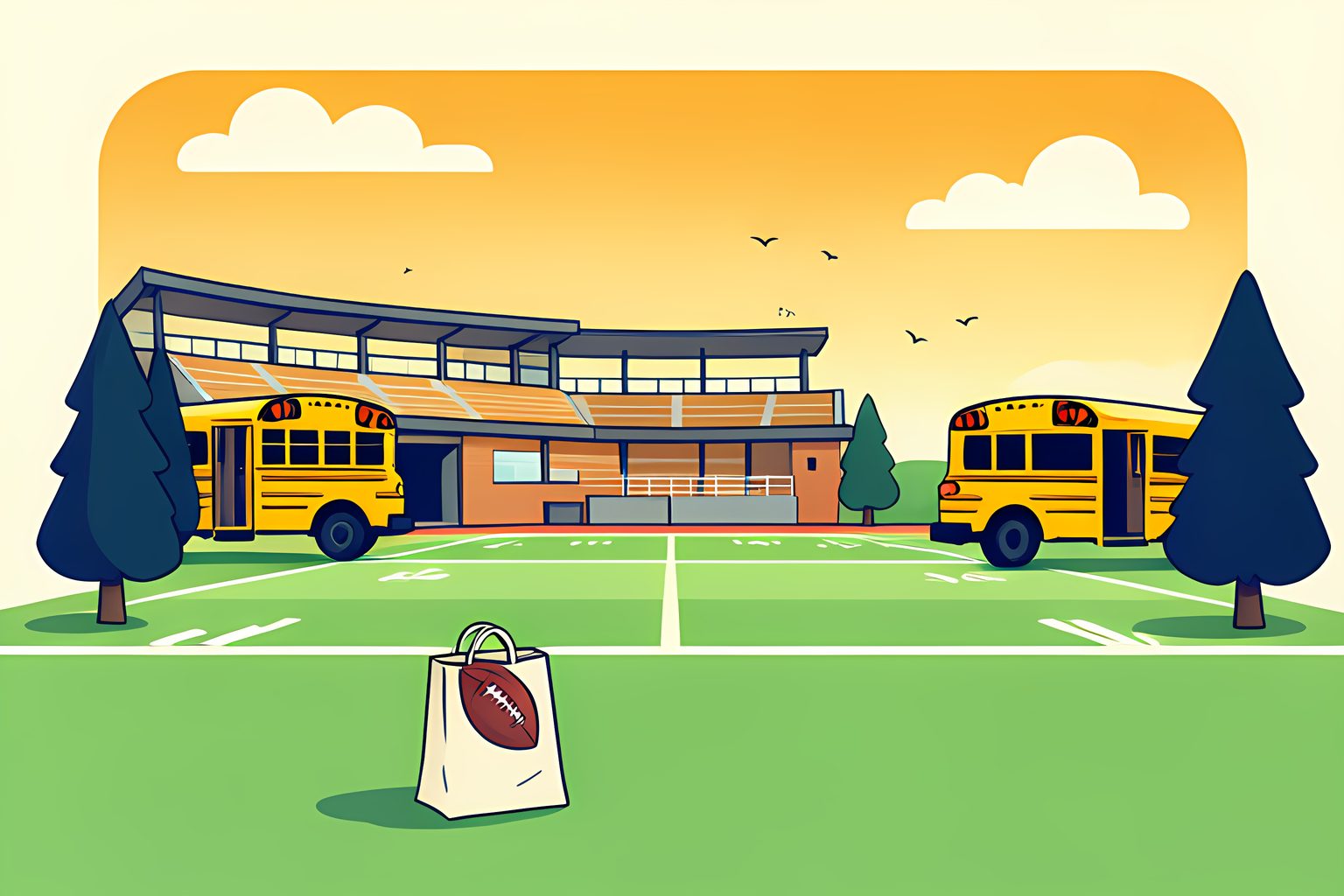
In 1981, minutes before Erk Russell was introduced as Georgia Southern's new head coach, somebody from the college was sent to the K-Mart across the street to buy a football. The school had no tackling dummy, no pads and not even enough grass for a practice field, according to the university's own retelling of that day. I have read a lot of college football origin stories, and this is the one I would hand to anyone asking what Georgia Southern football actually is. Nearly everything the program still does grows out of it.
A program that slept for four decades
Football at the school in Statesboro, Georgia, is older than most fans assume. A team called the Blue Tide played from 1924 to 1941 and managed just four winning seasons in those 17 years, the New Georgia Encyclopedia notes. After Pearl Harbor the players enlisted, and the sport simply stopped. It stayed stopped for 40 years.
The revival belonged to President Dale Lick, who pushed it through despite a faculty senate vote against bringing the sport back, according to the program's documented history. His reasoning, as the encyclopedia records it, was blunt: "There is something about football that really gets people moving in the South." He then landed one of the best-known assistant coaches in the state. Russell had just won the 1980 national championship as Georgia's defensive coordinator, the man behind the "Junkyard Dawgs." Going from that sideline to a college with no team was either brave or slightly mad. Probably both.
Walk-ons, a mobile home and a police team from Jacksonville
One hundred and thirty-four "enthusiastic non-athletes" turned out for the first tryouts, held on the campus tennis courts. The coaching office was a mobile home. Equipment was scavenged from nearby schools, and the first scrimmage came five months after Russell was hired, with players in mismatched helmets and hand-me-down pads. For two seasons Georgia Southern was a club team, playing the Florida State junior varsity, the Fort Benning Doughboys and a semi-pro side made up of police officers from Jacksonville.
The whole town chipped in. The university's account says a ten-dollar bill bought several pairs of socks or workout shorts, and larger gifts went to scholarships. That detail is the one I keep coming back to. Plenty of programs were built by one rich donor; this one was partly built by people buying socks.
When you don't have the best of everything, make the best of everything you have.
Why the helmets and the buses look the way they do
Georgia Southern's famously plain uniform is a budget line that became a brand. When the program restarted, the equipment money stretched only to plain white practice pants, so the practice pants became the game pants. Russell bought solid blue helmets and had players run a strip of tape down the middle, as Russell's biography and the school's history both recount. Decades of winning later, the look barely changed, and I think that restraint is the smartest thing about it.
The buses came the same way. The Bulloch County Board of Education sold the college two old yellow school buses for one dollar each, and the university's traditions page says the team still rides yellow buses to home games. Before running onto the field, players head-butt a bronze bust of Russell, a nod to his habit of ramming his own bald head into helmeted players to celebrate, which often left his forehead bloodied. Then there is the drainage ditch he renamed, which has its own story in our look at Beautiful Eagle Creek.
Six national titles in 16 seasons
Allen Paulson, founder of Gulfstream Aerospace, gave $1.3 million toward a stadium, and Paulson Stadium was dedicated on September 29, 1984, the year the Eagles began playing at the NCAA Division I-AA level. The next season, in only the fourth year of the revived program, they won it all. Georgia Southern trailed Furman 21-6 at halftime of the 1985 championship game in Tacoma, Washington, and won 44-42 behind quarterback Tracy Ham.
It kept happening. The results below come from the program's championship record.
| Season | Head coach | Title game opponent | Score |
|---|---|---|---|
| 1985 | Erk Russell | Furman | 44-42 |
| 1986 | Erk Russell | Arkansas State | 48-21 |
| 1989 | Erk Russell | Stephen F. Austin | 37-34 |
| 1990 | Tim Stowers | Nevada | 36-13 |
| 1999 | Paul Johnson | Youngstown State | 59-24 |
| 2000 | Paul Johnson | Montana | 27-25 |
The 1989 team went 15-0, the first college team of the 20th century to win 15 games, and won its title at home in Statesboro. Russell retired right after it with an 83-22-1 record. Paul Johnson, who had coordinated the offense for the first two titles, came back to win two more, and running back Adrian Peterson ran for a championship-game record 247 yards in the 1999 final. That is the Georgia Southern Adrian Peterson, the 1999 Walter Payton Award winner, not the Minnesota Vikings star with the same name.
The winning changed the school, too. Enrollment nearly doubled during Russell's tenure, from 6,641 students in the winter of 1983 to 12,250 in the fall of 1990, according to Georgia Southern Magazine. It is hard to find a clearer case of a football team working as a recruiting brochure.
The FBS years
Georgia Southern moved up to the Football Bowl Subdivision and joined the Sun Belt Conference in 2014, and then did something almost nobody does: it won the conference outright in its first FBS season, going 8-0 in league play. Paulson Stadium, now officially Allen E. Paulson Stadium/Evans Family Field, seats 25,000. Clay Helton is in his fifth season as head coach in 2026, per the athletics department's season-opener preview. The rivals that matter most are Appalachian State and Georgia State.
We have kept this season's scores out of this page on purpose. They change every Saturday, and the program's official site does that job better. The part that holds still is the identity: a team that treats having little as an advantage, and still dresses like it.
A centennial that lands on Halloween
Russell was born on July 23, 1926, so 2026 is his centennial year. He died on September 8, 2006. Georgia Southern is marking the anniversary all season, with the main celebration set for Saturday, October 31, 2026. Executive deputy athletic director Ryan Hall told WSAV that bronze busts of Tracy Ham, Paul Johnson and Adrian Peterson will be unveiled that night, joining the monuments to Russell and to Freedom, the late bald eagle mascot. Players now start their walk into the stadium through the center gate, past Russell's monument.
He was an innovator in every sense of the word, always thinking differently and finding ways to get the very best out of his players and staff.
The live-eagle tradition is in its own quiet rebuilding year. Its new bird is still in training, and Freedom II's road to her first flight is a story worth following. None of it, the busts, the buses, the eagle or the six trophies, would exist if a coach in 1981 had waited for proper equipment. He sent someone to K-Mart instead.
Sources
Every factual claim above traces to one of these. Links open in a new tab.
- Celebrating the Birthdate of Legendary Coach Erk Russell
- Erk Russell at 100: Remembering the Man, His Friends and the Round Table at Snooky's
- Georgia Southern Celebrates Icon's 100th Birthday
- Traditions
- Georgia Southern Football
- Georgia Southern Eagles football
- Erk Russell
- What's new at Paulson Stadium in 2026
- GAME PREVIEW: Eagles Set to Open 2026 Season