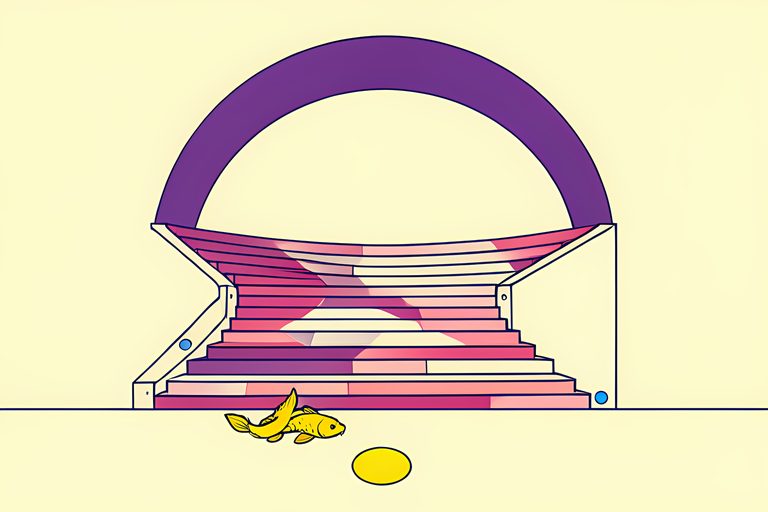
Freddie Mercury's Wembley Mural vs. Montreux Statue

One tribute turns fragments into a face for a few months. The other has faced Lake Geneva since 1996. Their differences explain why both endure.

One Freddie Mercury tribute wants you to stand still at a yellow dot. The other lets you walk around it beside Lake Geneva. I think that difference explains more than the material ever could. Wembley Park's mural is a temporary trick of perspective; Montreux's bronze statue is a permanent landmark. Both honor the same artist, yet each asks a visitor to remember in a completely different way.
The new piece, I'm Mr. Mercury, is an anamorphic mural by Frank Styles across Wembley Park's Spanish Steps. It runs through December 2026. The Montreux statue has stood on the Place du Marché lakeside promenade since 1996. Putting them side by side does not settle which is better. It reveals two surprisingly good answers to a tougher design question: how do you make a public artwork feel alive after the first photograph?
| Feature | Wembley Park mural | Montreux statue |
|---|---|---|
| Setting | Spanish Steps between Wembley Stadium and OVO Arena Wembley | Place du Marché on the Lake Geneva promenade |
| Form | An anamorphic portrait across 58 stair steps | A three-metre bronze sculpture |
| Viewer's role | Find the marked point where fragments form a face | Move around a fixed raised-fist pose by the lake |
| Time scale | Free outdoor installation through December 2026 | Installed in 1996 and accessible year-round |
Wembley turns the viewer into a stagehand
At Wembley, the portrait exists fully only from the designated viewing point. Walk to either side and its color, line and symbols split back into their component parts. Wembley Park's project page says the marked spot is about 65 feet from the central steps. The artwork is therefore not merely a picture of a performance. It gives the visitor a tiny cue, then makes the completed image depend on taking it.
Its surrounding details are active too. Koi refer to Mercury's interest in Japanese art and culture, while winged Virgo figures point toward the Queen crest he designed. The stairway is between the stadium and arena where Queen performed repeatedly, including Wembley Stadium appearances in 1985 and 1986. I checked the live archive rather than relying on the usual single-moment shorthand, and it gives the location a fuller musical history.
Montreux makes room for a quieter ritual
Montreux goes in the opposite direction. The statue by Czech sculptor Irena Sedlecká is three metres high, faces Lake Geneva and shows Mercury with microphone and raised fist in the yellow jacket associated with Wembley in 1986. Switzerland Tourism says fans leave flowers, letters and photographs at its base. Nothing needs to line up. The changing part is the shoreline, the weather and what people bring.
The location reflects a different strand of the story. Montreux Riviera says Mercury lived there and recorded with Queen in the town, while the former Mountain Studios is now presented as Queen: The Studio Experience. There is a tiny source wrinkle worth keeping honest: Montreux Riviera's statue page says six Queen albums were recorded there, while Switzerland Tourism says seven. We do not need to force a count to make the point. The documented connection between the town, the studio and the statue is already rich.
Why the comparison is not really a contest
A statue offers continuity. You can return to the same gesture each year, and the flowers make a small communal record without anyone having to curate it. The mural offers surprise. From its single sweet spot, a face appears out of architectural fragments, then disappears as you move. One holds a pose. The other borrows one.
We have a habit of calling every public tribute a monument, but these two works are more specific than that. Montreux is a destination built around long familiarity. Wembley is an encounter built around timing and a bit of visual mischief. The koi on the stairs are a delightful tell: this is not trying to turn Mercury into a marble saint. It remembers taste, graphic design and theatrical scale.
For a visitor, the practical distinction is simple. The Wembley work is free, outdoors and temporary, listed through December 2026. The Montreux sculpture is free to access year-round. I would choose neither as a substitute for the other. The nice outcome is that each makes the case for its own setting: one needs steps and a viewpoint, the other needs a lake, a pedestal and room for flowers.
Sources
Every factual claim above traces to one of these. Links open in a new tab.