Trace Iga Świątek's Heavy-Forehand Game

The Polish star's tennis looks ferocious because several quiet pieces work together: a spinning forehand, restless feet, early contact and a return game that keeps the other player from getting comfortable.
A heavy tennis ball has a particular look. It climbs above the net, appears almost polite for a second, then drops with the bad manners of a stone into a pond. I think that visual explains Iga Świątek better than a list of trophies does. Her game is built to make the court feel smaller for the opponent: spin supplies shape, quick feet supply time, and early strikes turn ordinary exchanges into a hurry.
Start with the forehand's unusual shape
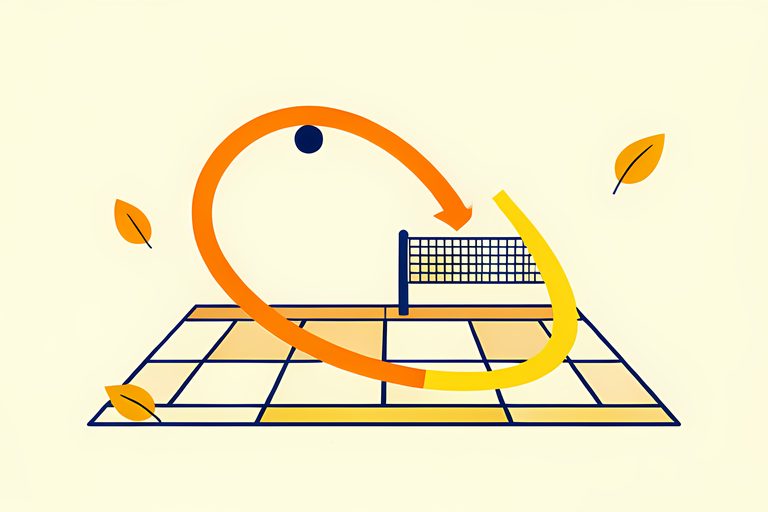
Świątek is right-handed, and her forehand is the loudest part of the picture. A technical breakdown published by Roland-Garros put its spin at more than 3,400 rotations per minute. That Roland-Garros analysis also describes an extreme grip. In plain English, she can send the ball high and heavy, then still bring it down inside the court. The shot does not merely travel fast. It arrives with a question attached: can the other player take this bounce on time?
The grip is not a party trick. Tennis.com’s technical look identifies it as a western grip, uncommon among top women, and links it to an attacking baseline game. I would not tell a recreational player to copy it from a video. Technique belongs with a coach. But it is useful for a viewer to notice what it buys her: clearance over the net, a steep drop, and an inviting target that turns uncomfortable once it bounces.
Her feet do much of the explaining
A spinning forehand only becomes dangerous if its owner reaches the ball in balance. That is why the small shoe-squeak detail matters. In its report on Świątek’s January 2025 win over Emma Raducanu, the Associated Press paired her high-bouncing forehands with scrambling court coverage and strong returns. One works because of the other. She can defend a wide ball, recover, and then use the next ball to take back the center of the court.
That recovery changes the emotional rhythm of a rally. A rival may hit a shot that looks good enough, only to see it come back with depth. Then the rival has to create another opening. I find this the clearest reason her tennis can feel relentless without being one-note power: the pressure is made from repetition, position and decisions, not simply from swinging harder than everyone else.
The viewing shorthand
- Ball shape
- Heavy topspin sends forehands high, then sharply down.
- Court position
- She looks to take time by stepping into workable balls.
- Defense
- Quick recovery makes a would-be winner into one more decision.
- Return
- Strong returning keeps opponents from settling into easy service games.
The return stops the point from starting quietly
Serving gives a player a chance to dictate the opening, so elite returning is a wonderfully disruptive skill. In the 2024 French Open final, AP’s match report noted that Świątek broke Jasmine Paolini at love with a return winner, then used a 25-shot exchange to establish control. That is not evidence that every return is a winner. It is evidence of the pattern: she treats the opponent's serve as a problem to solve immediately.
The 2024 Rome final against Aryna Sabalenka offers a more granular example. WTA’s account says Świątek's depth on return helped create an early break, while her seven saved break points kept the advantage from leaking away. Those two details belong together. Aggression earns openings; discipline preserves them. The best matches make that exchange visible point by point.
Why clay and high bounces are such a natural fit
Clay gives a topspin ball extra time and height to become bothersome. Świątek’s own description is more measured than the legend around her. In a 2025 Indian Wells piece, the WTA reported her saying that high bounces make her topspin more visible, but that the surface helps rather than doing the job for her. That is the right distinction. Conditions can flatter a strength. They cannot manufacture the timing, movement or choices behind it.
Her record gives the explanation some weight without turning it into a permanent law. The WTA player page lists multiple Roland-Garros titles alongside hard-court titles at Indian Wells, Cincinnati and the US Open. And the WTA's 2022 Sabalenka preview captured her deliberate move toward a more attacking style as the game became faster. We should read the clay-specialist label as a clue, not a cage.
The style is a set of habits, not a highlight reel
That is the part I hope lasts longer than a clipped winner. A highlight can show the dramatic forehand, but the game lives in the less glamorous repetitions: split step, recover, turn the shoulders, make a difficult ball land deep, then be ready for the next one. The ingredients can look different in a breezy afternoon, on quicker cement, or against a hard hitter who removes time. The governing idea remains the same. Świątek tries to make each exchange physical, precise and just uncomfortable enough that the other player has to solve it twice.
A better way to watch the next match
I check four things when Świątek is on court: how high the forehand is bouncing, whether she is taking the ball early, whether the returner is making the server play an extra shot, and whether a difficult defensive ball comes back deep. The score may say 30-all. Those details tell you why it got there.
There is a cheerful bonus to this way of watching. You begin to see an apparently simple crosscourt forehand as a piece of craft: the grip, the legs, the margin above the net, the spin, then the recovery for the reply. I would take that over a vague claim of dominance every time. It lets the match stay a match, with an opponent and changing conditions, while showing exactly what makes Świątek so difficult to unsettle.
Sources
Every factual claim above traces to one of these. Links open in a new tab.
- Iga Swiatek: The five keys to her mighty forehand
- TECH Talk: The secret to Iga Swiatek's world class forehand
- Iga Swiatek Player Stats & More
- Australian Open: Swiatek easily beats Raducanu during a 6-1, 6-0 rout
- Iga Swiatek wins third French Open title by defeating Paolini
- Swiatek beats Sabalenka to win third Rome title
- Swiatek's secret ingredient? Heavy topspin and a side of bagels
- Swiatek and Sabalenka renew rivalry in US Open semifinals