Why the Minnesota State Fair Feels Like a Statewide Reunion

The Fair's nickname makes sense once you see its real engine: Minnesotans bringing work, learning and local oddities into public view.
In 2025, 4,154 Minnesota 4-H youth brought 1,848 projects to the State Fair and showed 2,921 animals. Those numbers get closer to the Fair's appeal than the Midway ever could. A kid's project, a breeder's animal, a quilt, a student project and a stage act can all be treated as things worth stopping for. University of Minnesota Extension's Fair overview records that very particular crowd of makers and learners.
The phrase Great Minnesota Get-Together has lasted because it names that habit. Promotional language, of course, can still tell the truth. This Fair is not mainly a recap of what happened in Minnesota. Here, Minnesota puts its work on a table, in a stall, under a glass case or on a stage, then lets strangers look closely. The rides and treats are part of the pleasure. They are not the whole plot.
The short answer
- Its original job
- The Minnesota Agricultural Society was founded in 1854 to encourage farming and highlight the region's agriculture.
- Its present scale
- The Fair now spans 322 acres and brings together competitions, exhibits, performers and public institutions.
- Its rhythm
- Since 1975, the Fair has run for 12 days and ended on Labor Day.
- The human trick
- It gives things people made or learned all year an audience that did not come only for them.
It began as a public showing of what Minnesota could do
The governing agricultural society formed in 1854, and the first Minnesota State Fair followed in 1859 near what later became downtown Minneapolis. Its early purpose was bluntly practical: encourage farming and demonstrate what the young region could produce. The Fair's history and the Minnesota Historical Society's account of its origins both describe a gathering built around crops, livestock, handiwork and the case for a growing state. That starting point matters. Its original design was to make local knowledge visible, not merely to sell tickets.
That mission widened without disappearing. The official history says agriculture remains the primary focus, even as entertainment, technology, industry, education and government institutions have joined it. That mix can look untidy from a distance. Up close, it is the point. A state is full of people doing wildly different work. For twelve days, the Fair gives them a shared address.
A fixed fairground turned a traveling event into a habit
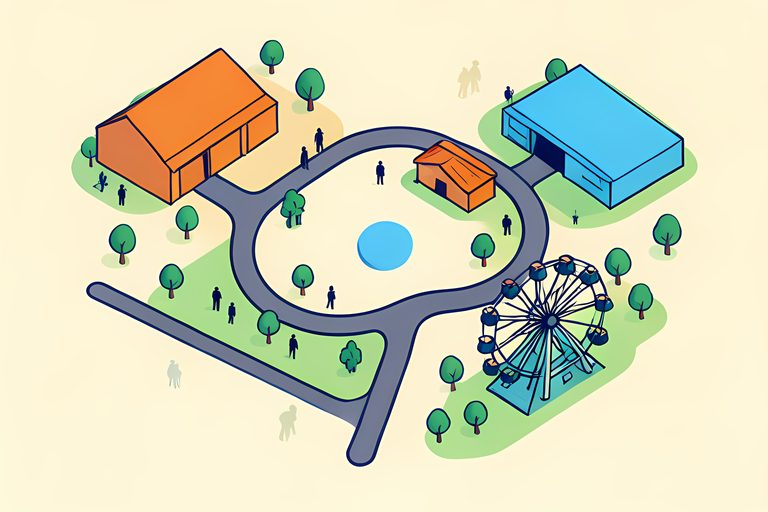
Before 1885, the event bounced among Minneapolis, St. Paul, Rochester, Red Wing, Winona and Owatonna. Moving livestock, exhibits and expectations between those places was a serious undertaking. Civic groups in Minneapolis and St. Paul both pushed for a permanent home, but neither city got to write the ending alone. Ramsey County donated a 210-acre poor-farm site for the Fair, and the grounds eventually grew to 322 acres. The Fair's history page lays out that settlement. A reunion needs a place people can picture before they arrive.
The fixed address also lets traditions accumulate without becoming museum pieces. The Fine Arts Center, the Grandstand, the Agriculture Horticulture Building and the old competition culture are not interchangeable attractions. They are recurring rooms in a giant annual house party. A visitor can skip one completely, return the next year and still recognize the larger place. That kind of continuity is rarer than it sounds.
Its social trick is giving unlike work equal dignity
The competition list makes this plain. Its program groups together 4-H, agriculture and horticulture, creative activities, FFA, fine arts, horses, K-12 work and livestock exhibitions. No one is pretending that a quilt and a dairy animal are the same thing. Instead, the program says both deserve careful attention in their own setting. The official competition guide is much more revealing than a simple schedule because it shows the Fair's underlying structure.
Rules keep that generosity from becoming mush. The Creative Activities program has distinct divisions for items such as handcrafts, needlecraft, garment making and collections, and it directs entrants to department rules before registration. Minnesota residency is required. Its competition page does not romanticize the paperwork, which is good. A ribbon means more when the class, the standard and the person who did the work are all legible.
Young people are not parked at the edge of the story
Minnesota 4-H describes the Fair as a state showcase for young people who have spent months building skills, then discussing their work with experts at county and state fairs. The public part is unusually generous: participants lead tours, offer demonstrations and make their projects understandable to someone who did not grow up around them. Extension's explanation is a welcome corrective to the idea that youth exhibits are merely cute scenery. They are learning in public, which takes nerve.
Then there is the Fair's wonderfully specific sense of fun. The 4-H program includes a llama-alpaca costume event in which young exhibitors receive points for creativity and for training an animal to wear a costume. This is not a throwaway gag. It pairs patient animal work with a little theatrical absurdity, and it makes the larger philosophy easy to love. Serious effort gets a ribbon. Serious effort also gets to wear a cape sometimes.
The calendar gives strangers time to overlap
The Fair's 12-day length is not ancient custom. The Minnesota Department of Natural Resources says the Labor Day-ending run began in 1975, after earlier fairs lasted from six to eleven days. For 2026, the Fair says the dates are August 27 through Labor Day, September 7. The DNR's calendar history and the Fair FAQ are useful together: one explains the rhythm, and the other supplies the current date.
Twelve days gives the event room to be personal without becoming exclusive. One family might arrive for a project, another for a performance, a third for a favorite annual errand. They still brush shoulders on the same avenues. That overlap is the real get-together. It asks very little of anyone except curiosity and decent walking shoes.
The smallest traditions explain the big one
The Fair's history resources include a 12-stop walking tour, created with the Minnesota Historical Society and the State Fair Foundation. That modest detail is a clue. The organizers do not treat the past as a single plaque near the gate. They scatter it around the grounds, where a person can encounter it between whatever else brought them there. The history center and walking-tour information make room for the old stories without forcing every visitor into a history lesson.
So the nickname lands because the Fair is a civic project disguised as a day out. It gathers people who raise things, build things, stitch things, study things and perform things, then lets the rest of the state notice. The most delightful detail is that it has preserved enough room for a carefully trained llama in costume. A statewide reunion should have at least one guest who makes everybody look twice.
Sources
Every factual claim above traces to one of these. Links open in a new tab.