The Suspended Barium Ion Powering IonQ's Quantum Computing Leap

How individual atoms trapped in vacuum chambers and manipulated by visible lasers turn fundamental atomic physics into scalable commercial computing.
When search queries surged for IonQ on September 23, 2026, I pulled the engineering documentation behind the company's recent hardware announcements. At the heart of the Maryland company's commercial push sits a physical mechanism that reads like science fiction made tangible: capturing single atoms of barium, suspending them in an ultra-high vacuum chamber with oscillating radio-frequency electric fields, and manipulating their energy levels with visible laser light. While financial commentary reacts to quarterly guidance and foundry acquisitions, our editorial team found that the underlying physics of trapped-ion hardware offers something far more compelling: an approach where nature does the hardest manufacturing work on our behalf.
Most quantum computing programs attempt to fabricate artificial quantum circuits from scratch on silicon wafers. Companies like IBM and Google build microscopic loops of superconducting metal called Josephson junctions. However, microscopic variations during lithography mean that no two artificial qubits on a silicon wafer are ever truly identical. IonQ takes the opposite path. Instead of manufacturing synthetic qubits, the company harnesses naturally occurring barium-137 ions. Every single barium atom in the cosmos has the exact same mass, nuclear spin, and electronic energy transitions. They are identical by fundamental physical law. That natural uniformity eliminates the device-to-device manufacturing variations that plague synthetic hardware.
How Radio-Frequency Paul Traps Suspend Single Atoms in Free Space
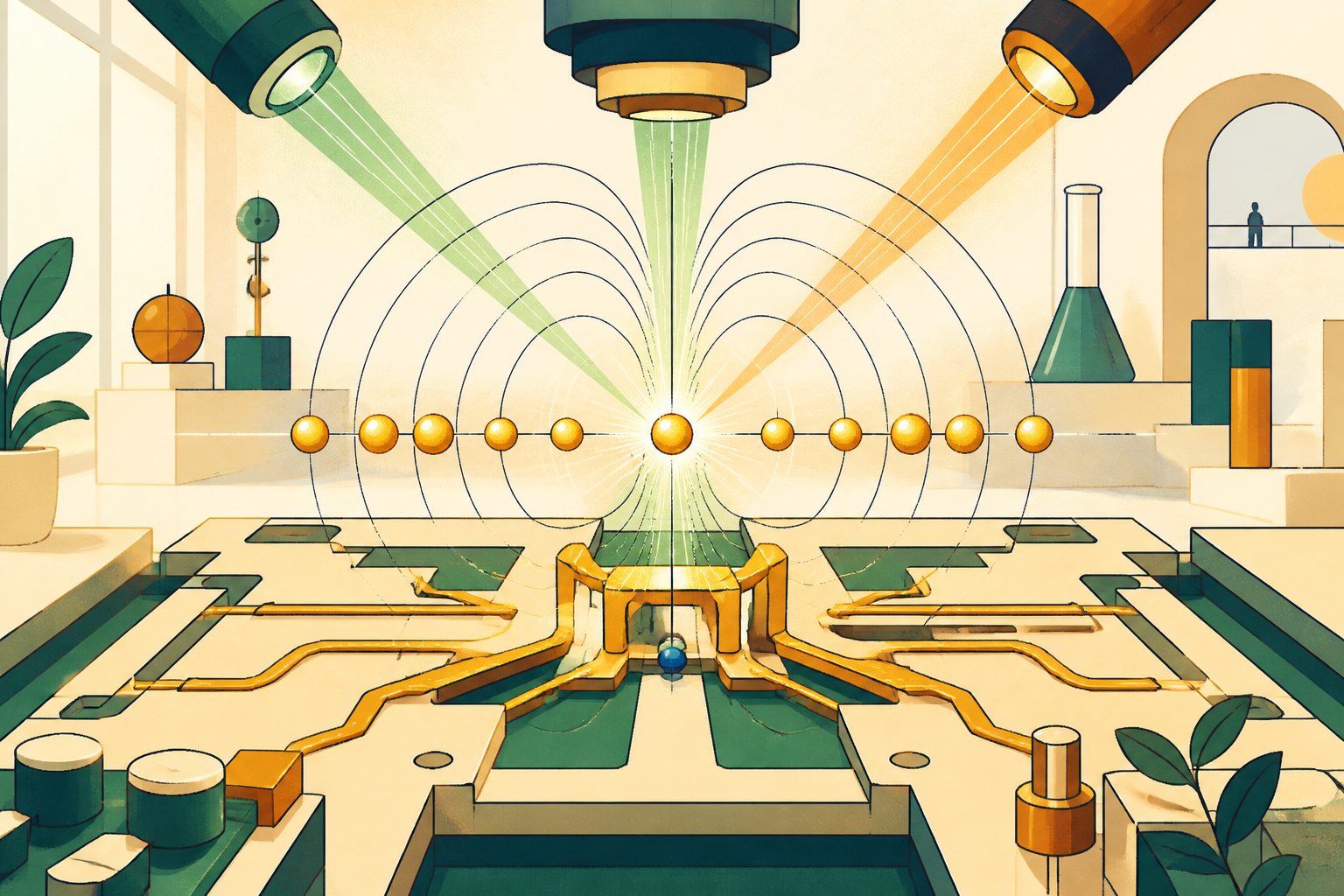
To turn a free atom into a functional quantum bit, researchers must first isolate it completely from thermal vibration and stray magnetic fields. IonQ accomplishes this using a microfabricated surface Paul trap. Inside an ultra-high vacuum chamber pumped down to pressures below 10^-11 Torr (a vacuum emptier than interplanetary space), tiny vaporized barium atoms are ionized by a focused laser beam, stripping away a single electron to produce positively charged ions.
Once ionized, the atoms encounter an array of microfabricated surface electrodes. Earnest Wolfgang Paul won the 1989 Nobel Prize in Physics for developing the quadrupole ion trap, and modern quantum chips build directly upon his foundational work. By applying oscillating radio-frequency voltages alongside static direct-current voltages, the trap generates a dynamic saddle-shaped electric potential. The positively charged barium ions are cradled in a straight, motionless linear chain, levitating a fraction of a millimeter above the chip surface without ever touching a physical wall. The electric forces act as a frictionless, perfectly smooth cradle.
Once trapped, the ions are cooled to within a thousandth of a degree above absolute zero using laser cooling techniques pioneered by David Wineland at NIST. By tuning laser frequencies slightly below atomic resonances, incoming photons absorb the ions' residual kinetic motion, freezing them into an ordered, crystal-like chain.
IonQ Trapped-Ion Architecture at a Glance
- Core Qubit Species
- Barium-137 positive ions (transitioned from Ytterbium-171)
- Confinement Method
- Microfabricated surface radio-frequency (RF) Paul traps in ultra-high vacuum
- Operating Wavelengths
- Visible green (532 nm) and near-infrared optical laser lines
- Gate Connectivity
- All-to-all qubit coupling via shared collective vibrational modes (phonons)
- Semiconductor Foundry Partner
- SkyWater Technology custom fabrication facility in Bloomington, Minnesota
Why Transitioning from Ytterbium to Barium Matters
Early trapped-ion systems relied heavily on ytterbium-171 ions. Ytterbium served the field well for decades, but it requires deep ultraviolet lasers (operating near 355 nanometers and 369 nanometers) to drive quantum logic gates. Ultraviolet photons carry high energy, which gradually degrades optical lenses and makes photonic routing through standard silicon waveguides difficult. I noticed in IonQ's technical papers that shifting to barium-137 completely changes this engineering equation.
Barium-137 operates across visible green and near-infrared wavelengths (including 493 nanometers, 532 nanometers, and 650 nanometers). Because visible light travels cleanly through conventional optical fibers and photonic integrated circuits without solarizing glass or burning delicate optical coatings, engineers can integrate lasers directly onto microchips. Furthermore, barium boasts superior state preparation and measurement (SPAM) fidelity, pushing single-qubit readout accuracy past 99.9%.
Quantum Logic Through Shared Vibrational Modes
How do two suspended ions perform a computational calculation together without wires connecting them? The answer relies on collective mechanical motion known as phonons. Because the suspended barium ions carry identical positive electrical charges, they strongly repel one another. When confined together in the Paul trap's electric cradle, they behave like tiny beads connected by invisible springs.
When a pair of laser pulses strikes one specific ion, the light imparts a precise momentum kick. That impulse travels through the entire chain as a collective vibrational wave, allowing any ion to perform an entangled two-qubit gate with any other ion in the trap. This property is called all-to-all connectivity. In contrast to planar superconducting chips where qubits can only interact with immediate neighbors on a grid, trapped ions can communicate across the entire register without routing swaps.
| Engineering Parameter | Physical Specification | Operational Advantage |
|---|---|---|
| Qubit Lifespan (T1) | Hours to days in dark states | Near-infinite memory stability compared to microsecond circuits |
| Coherence Time (T2) | Seconds to minutes | Allows thousands of sequential gates without decoherence collapse |
| Readout Method | Fluorescence imaging on EMCCD camera | Direct state detection with greater than 99.9% discrimination |
| Control Interface | Acousto-optic modulators and photonic waveguides | Software-programmable optical pulses reconfigure gates on the fly |
| Operating Temperature | 4 Kelvin to room temperature vacuum | Avoids complex dilution refrigerators needed for millikelvin circuits |
From Physics Laboratory to SkyWater Semiconductor Foundry
For years, critics argued that trapped-ion computers were wonderful laboratory physics experiments that could never scale into mass-manufactured hardware. Aligning hundreds of free-space laser beams onto suspended atoms required rooms full of optical tables, mirrors, and manual micrometers. To overcome this limitation, IonQ completed its acquisition of SkyWater Technology in 2026, bringing commercial semiconductor fabrication in-house.
At SkyWater's Bloomington, Minnesota foundry, engineers manufacture ion traps using standard CMOS-compatible lithography. Instead of shining lasers through bulky external windows, new chips embed photonic waveguides, splitters, and electronic qubit control (EQC) electrodes directly beneath the trap surface. The lasers route inside the silicon itself, delivering light straight up into the levitating ions from below. Through-silicon vias eliminate messy wire bonds, creating clean, modular quantum processing units.
When we step back from the technical specifications, there is a delightful elegance to this architecture. Human manufacturing at the nanometer scale will always face tiny variations in atomic lattices and material impurities. Trapped-ion computing sidesteps that struggle by delegating the qubit's creation to nature itself: an atom that was formed billions of years ago in a dying star remains the world's most flawless quantum bit.
Sources
Every factual claim above traces to one of these. Links open in a new tab.
- IonQ Demonstrates Industry’s First End-to-End Real-Time Quantum Error Decoder
- Barium Qubits for Scalable Quantum Computing
- Trapped-Ion Quantum Computing Technology Overview
- The Nobel Prize in Physics 2012: David J. Wineland
- Trapped-Ion Quantum Computing Research and Standards
- High-fidelity gates with barium ion qubits in surface Paul traps
- IonQ (IONQ) Boosts Guidance After SkyWater Semiconductor Deal and Superion Launch
- SkyWater Technology Custom Foundry Solutions and QPU Fabrication