Trapped Ions vs. Superconducting Qubits in Commercial Quantum Systems

How natural atomic stability and nanosecond circuit speed represent two radically different philosophies for building commercial quantum hardware.
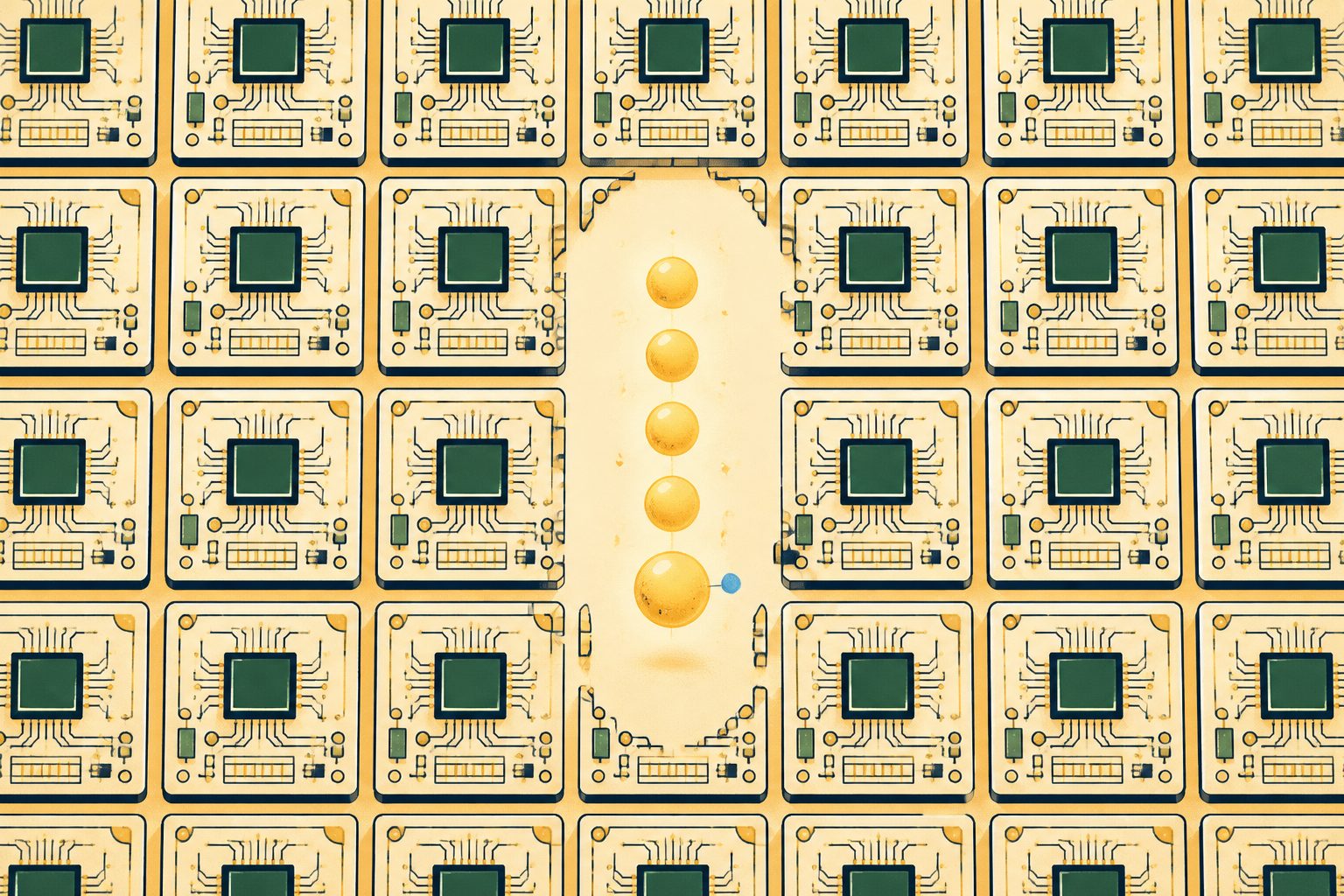
When comparing commercial quantum computing roadmaps, I always return to a central fork in modern physics: do you manufacture artificial quantum circuits out of printed metal on silicon, or do you isolate natural atoms suspended in free space? This choice separates the two dominant hardware paradigms in the industry today: superconducting transmon qubits (championed by IBM, Google, and Rigetti) versus trapped-ion systems (led by IonQ and Quantinuum). Each approach represents a coherent, brilliantly engineered philosophy with distinct operational advantages.
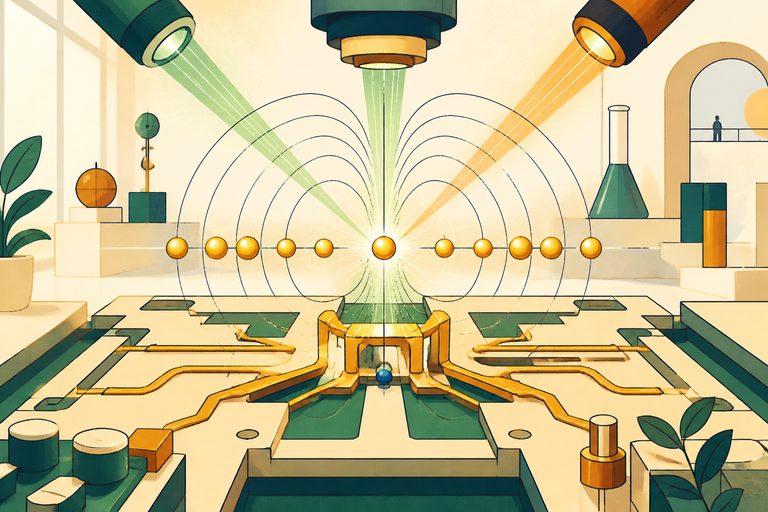
Superconducting systems treat quantum bits as microelectronic devices. By etching microscopic Josephson junctions onto silicon wafers, engineers create non-linear LC oscillator circuits that behave as artificial atoms. Trapped-ion systems take real atoms (such as barium-137 or ytterbium-171), strip an electron to give them an electric charge, and suspend them in ultra-high vacuum using radio-frequency electromagnetic fields. Let's compare how these foundational physical differences shape real-world performance.
Coherence Time Versus Gate Speed
The most fundamental tradeoff between the two architectures lies in the relationship between gate speed and quantum coherence time. Superconducting qubits execute logic operations at blazing speed: typical single-qubit and two-qubit gates complete in 10 to 50 nanoseconds. However, because these synthetic circuits couple strongly to their solid-state substrate, their quantum information decays rapidly. Superconducting coherence times (T2) are typically measured in dozens or hundreds of microseconds.
Trapped ions occupy the opposite end of the physical spectrum. An isolated barium ion in an ultra-high vacuum chamber is shielded from solid-state surface defects, allowing it to maintain quantum coherence for seconds, minutes, or even hours in specialized nuclear spin states. Gate operations, driven by optical laser pulses or focused radio-frequency fields, take longer (typically 10 to 100 microseconds). Because the coherence time is millions of times longer than the gate duration, trapped-ion systems can execute deep, complex computational algorithms before decoherence corrupts the calculation.
| Architectural Metric | Trapped Ions (IonQ, Quantinuum) | Superconducting Circuits (IBM, Google) |
|---|---|---|
| Physical Qubit Basis | Natural identical atoms (Barium-137, Ytterbium-171) | Lithographic Josephson junctions on silicon wafers |
| Coherence Time (T2) | Seconds to minutes (extremely stable) | 50 to 300 microseconds (susceptible to chip noise) |
| Two-Qubit Gate Time | 10 to 100 microseconds (slower) | 10 to 50 nanoseconds (extremely fast) |
| Qubit Connectivity | All-to-all across trapped chain via shared phonons | Nearest-neighbor planar coupling on 2D grid |
| Cooling Requirements | Room temperature vacuum or 4 Kelvin cooling | 10 to 15 milliKelvin dilution refrigerators |
| Manufacturing Variation | Zero variance (all atoms are identical by nature) | Microscopic fabrication tolerances across wafers |
Physical Connectivity and Cryogenic Scaling
Another crucial differentiator is qubit connectivity. On a planar superconducting chip, each qubit connects only to three or four physical neighbors on a two-dimensional grid. If qubit 1 needs to interact with qubit 50, the system must execute a long chain of intermediate SWAP gates, which adds substantial noise and degrades fidelity. Trapped ions utilize shared acoustic vibrations (phonons) within the electric trap to allow any ion to directly entangle with any other ion in the register, eliminating swap overhead.
The control wiring overhead also diverges dramatically. In superconducting systems, every single qubit requires multiple coaxial cables running from room-temperature electronics down through the cryogenic stages to the chip. As systems grow toward thousands of qubits, heat leakage through thousands of copper cables becomes a severe engineering bottleneck. Trapped-ion systems, by contrast, control dozens of suspended atoms using multiplexed laser beams or integrated photonic waveguides on a single chip surface.
Finally, the physical infrastructure differs vastly. Superconducting circuits require massive dilution refrigerators using rare helium-3 isotopes to cool chips down to 15 milliKelvin (colder than interstellar space). These multi-ton refrigerators consume enormous electrical power and limit modular scaling. Trapped ions hold their atomic qubits suspended in vacuum at room temperature or inside compact 4-Kelvin cryostats. Furthermore, because trapped ions naturally emit single visible photons, separate ion-trap modules can be networked together using standard optical fiber cables.
We see a poetic harmony in this competition. Whether constructing synthetic microelectronic cathedrals on silicon or conducting laser symphonies with individual levitating atoms, both engineering schools are turning quantum mechanics into practical computation.
Sources
Every factual claim above traces to one of these. Links open in a new tab.
- Trapped-Ion vs Superconducting Qubits: A Comparative Physical Analysis
- Trapped-Ion Quantum Computing Technology Overview
- Quantum Computing Hardware Architectures and Coherence Benchmarks
- Demonstrating Quantum Advantage with Superconducting Quantum Processors
- Commercial Quantum Computing Roadmap and Hardware Milestones