Inside the Custom Anthracite Court Built for the Laver Cup

The unmistakable black surface was engineered to pop like theatre under arena lights while giving players razor-sharp optic tracking.
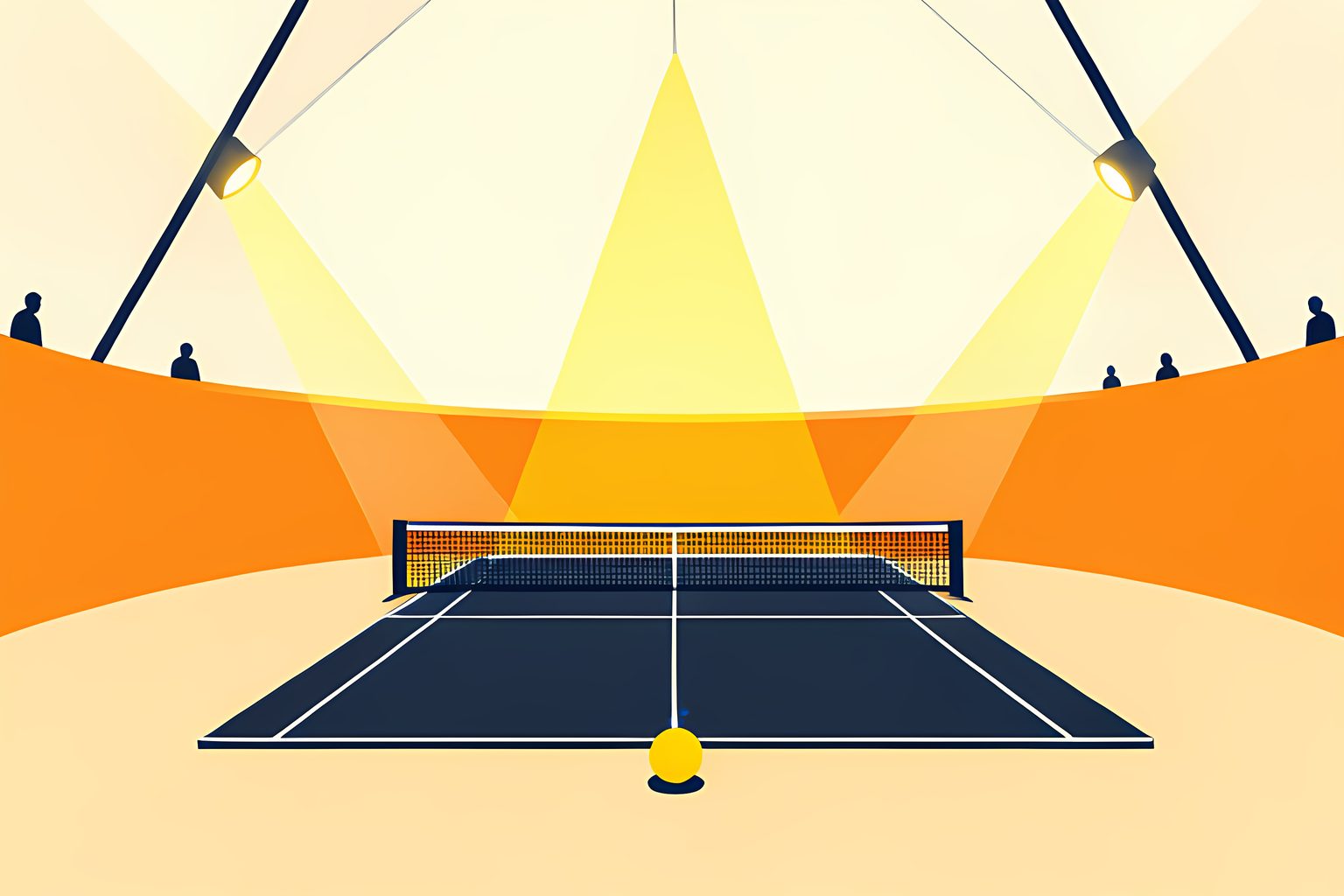
Inside major sports arenas, the visual signature of tennis has remained predictable for decades. Grand Slams and tour stops default to terracotta red clay, lush grass green, or bright hard-court blue. But when I first examined the technical specifications behind the Laver Cup's custom anthracite black playing surface, it became clear that this floor is a remarkable feat of materials science and theatre engineering. It does not simply look distinctive; it completely changes how players and cameras track a felt ball traveling at 130 miles per hour.
We at Joyful Take appreciate how industrial craftsmanship and bold visual design can elevate athletic drama. Built by California Sports Surfaces, the custom court was engineered specifically to solve a stubborn physics challenge: standard black coatings look dull, washed out, or grey under powerful high-definition broadcast lamps. Overcoming that hurdle required specialized chemistry.
Custom Anthracite Court Technical Specifications
- Surface Manufacturer
- California Sports Surfaces (custom proprietary acrylic coating formula)
- Official Shade
- Proprietary Laver Cup Anthracite Black
- Base Subfloor
- Modular interlocking timber puzzle assembled in under 48 hours
- Pace Rating
- Medium-fast acrylic blend with graded silica sand for uniform true bounce
- Lighting Intensity
- Over 2,500 Lux directional sports lighting focused exclusively on the court
- Primary Optical Benefit
- Maximum contrast against optic-yellow tennis balls with zero surface glare
The Pigment Chemistry of 'Laver Cup Black'
Creating a true black court is far more complex than applying dark paint over plywood. Early prototypes tested by tournament organizers in 2017 revealed that standard black pigments reflected arena lighting irregularly, turning into a hazy dark charcoal on television screens. To fix this, surface chemists developed a specialized resin blend saturated with deep carbon black pigments and ultra-fine silica sand.
The silica sand serves two vital roles. First, it provides the precise micro-texture required for player traction and medium-fast ball bounce. Second, it scatters ambient glare, creating a matte, non-reflective finish that absorbs light uniformly from every camera angle. The result is a deep, velvety anthracite field where optic-yellow tennis balls pop with dramatic visual clarity. The yellow felt practically glows against the dark base.
The acrylic layers are formulated to withstand heavy torque from rapid baseline direction changes. Elite athletes slide into corner shots and brake aggressively, putting immense mechanical friction onto the topcoat. By blending specialized elastomeric polymers into the paint emulsion, the surface resists scuffing while maintaining a consistent friction coefficient throughout all five sessions.
Theatrical Lighting and Optic Tracking Physics
The black court works hand-in-hand with an unconventional arena lighting setup. Traditional tournaments flood the entire stadium bowl with uniform light, illuminating the court, player boxes, and upper grandstands equally. The Laver Cup borrows its lighting philosophy from Broadway theatre and concert halls.
Powerful directional LED fixtures focus more than 2,500 Lux directly onto the 78-foot court rectangle, while the surrounding arena bowl is cast into gentle shadow. This high-contrast theatrical spotlight effect directs every ounce of spectator focus toward the athletes. For players, tracking a bright yellow ball against an unblemished dark surface provides an exceptionally clean visual horizon without distracting background clutter in the stands.
A Modular Jigsaw Built in Forty-Eight Hours
Because the Laver Cup moves to a new world-class indoor arena each year, the court cannot be permanently installed. Instead, it is manufactured as an interlocking modular timber subfloor consisting of hundreds of precision-cut panels. Technicians arrive on site less than a week before play begins, assembling the floor like a giant jigsaw puzzle inside iconic venues like The O2 in London.
Once locked together, multiple acrylic cushion layers, textured paint, and crisp white boundary lines are applied and cured. When I look at the finished stage inside the arena, it stands as proof that thoughtful engineering can turn athletic venues into stunning works of modern art. It gives tennis the grand stage it deserves.
Sources
Every factual claim above traces to one of these. Links open in a new tab.
- Building the Signature Black Court for the Laver Cup
- The Story Behind the Laver Cup's Iconic Black Court
- Laver Cup Court Design and Arena Lighting Innovation
- Why the Black Tennis Court Redefined Arena Aesthetics
- The Science of Ball Visibility on Anthracite Hard Courts
- Hosting the Laver Cup at The O2 London