Cards, cloth or flags: a field guide to football tifo displays

A stand can become a mosaic, a moving ceiling or a garden of flags. Here is how to tell which visual language you are watching.

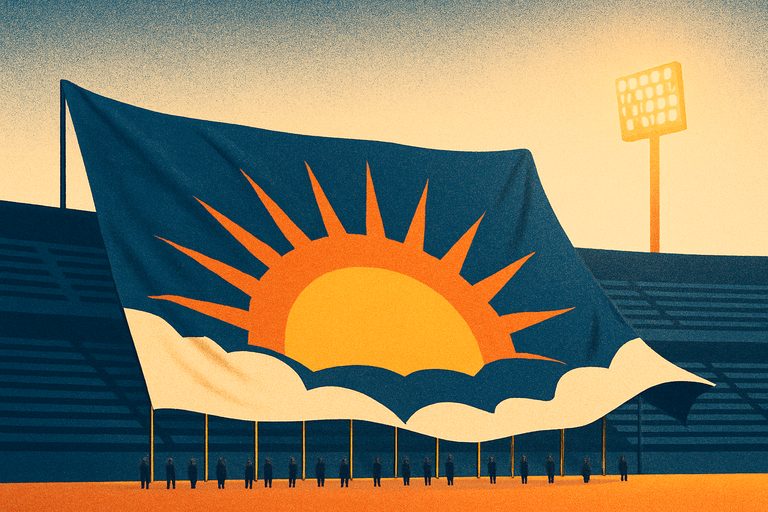
If the image looks precise from across the pitch but dissolves into plain rectangles when the camera gets close, you are probably watching a card mosaic. If a painted picture ripples over heads like a temporary roof, that is an overhead. The word tifo covers both, plus several smaller, livelier cousins. Knowing the forms makes the reveal more fun because you can see the particular trick each crowd is pulling off.
Five shapes a stand can take
| Display | What you see | What the crowd does |
|---|---|---|
| Card mosaic | Colored cards or panels resolve into one large image or pattern | Each person lifts the piece left at a specific seat |
| Overhead banner | One broad painted or printed sheet travels across a section | Rows pass it backward, keep it spread and return it on cue |
| Two-pole | A smaller fabric panel stays taut between two vertical poles | One or two people hold it facing the field |
| Flag display | Many separate flags create color, texture and constant movement | Flag bearers coordinate timing and mind the space around them |
| Layered choreography | Cards, curtains, banners or flags reveal in sequence or together | Different parts of the section perform different jobs |
The mosaic is a picture made of seats
Card displays work like very large, very patient pixels. Emerald City Supporters says the pieces are laid out as a matrix, with every card left exactly where the pattern needs it. That explains the odd experience of participating: the person in row 18 may see only a blue board, while the opposite stand sees a crest, face or sweep of color. BBC Sport likewise describes mosaics built when fans raise colored card or material as one image.
The overhead is a picture with weather
An overhead banner is one continuous surface, but it never behaves like a wall painting. Air gets underneath. Hands rise at different heights. The fabric crosses aisles and changes slope from row to row. Emerald City Supporters' guide asks people to pass the material backward, avoid striking the underside and keep it flat. Those instructions explain the best overheads: their calm appearance is an achievement, not a property of cloth.
Two-poles and flags keep the picture dancing
A two-pole, also called a two-stick, stretches a modest banner between upright poles. Orlando supporter group Ruckus describes it as a do-it-yourself stadium display usually handled by one or two people. It cannot cover a whole stand, which is precisely its charm. Several two-poles can pop up like handmade speech bubbles, disappear, then return during a lull.
Flags trade legibility for motion. A single flag is an accent; dozens become atmosphere. Portland's 107 Independent Supporters Trust tells participants to hold cards and fabric taut, avoid blocking rope-lift banners and return reusable flags after the match. A display therefore has foreground and background, even when everything seems to be fluttering at once.
Choreo is the full orchestra
Supporters often use choreo, short for choreography, when several coordinated elements must land together. One section might raise cards while another drops a curtain and flags fill the edges. The categories can overlap, and groups do not all label them identically. What matters is sequence. The stand has cues, roles and a brief performance window.
The sweetest way to watch any of these is to look for the handoff between individual and whole. One card is stationery. One flag is cloth on a stick. One corner of an overhead is mostly wrinkles. Then the view widens, and the stand has made a sentence without asking any single person to write it.
Sources
Every factual claim above traces to one of these. Links open in a new tab.