Why a Crocodile Gets a Stage at Australia Zoo

Australia Zoo's Crocoseum is spectacle on purpose. The more durable question is whether that spectacle leaves people with something better than a quick thrill.
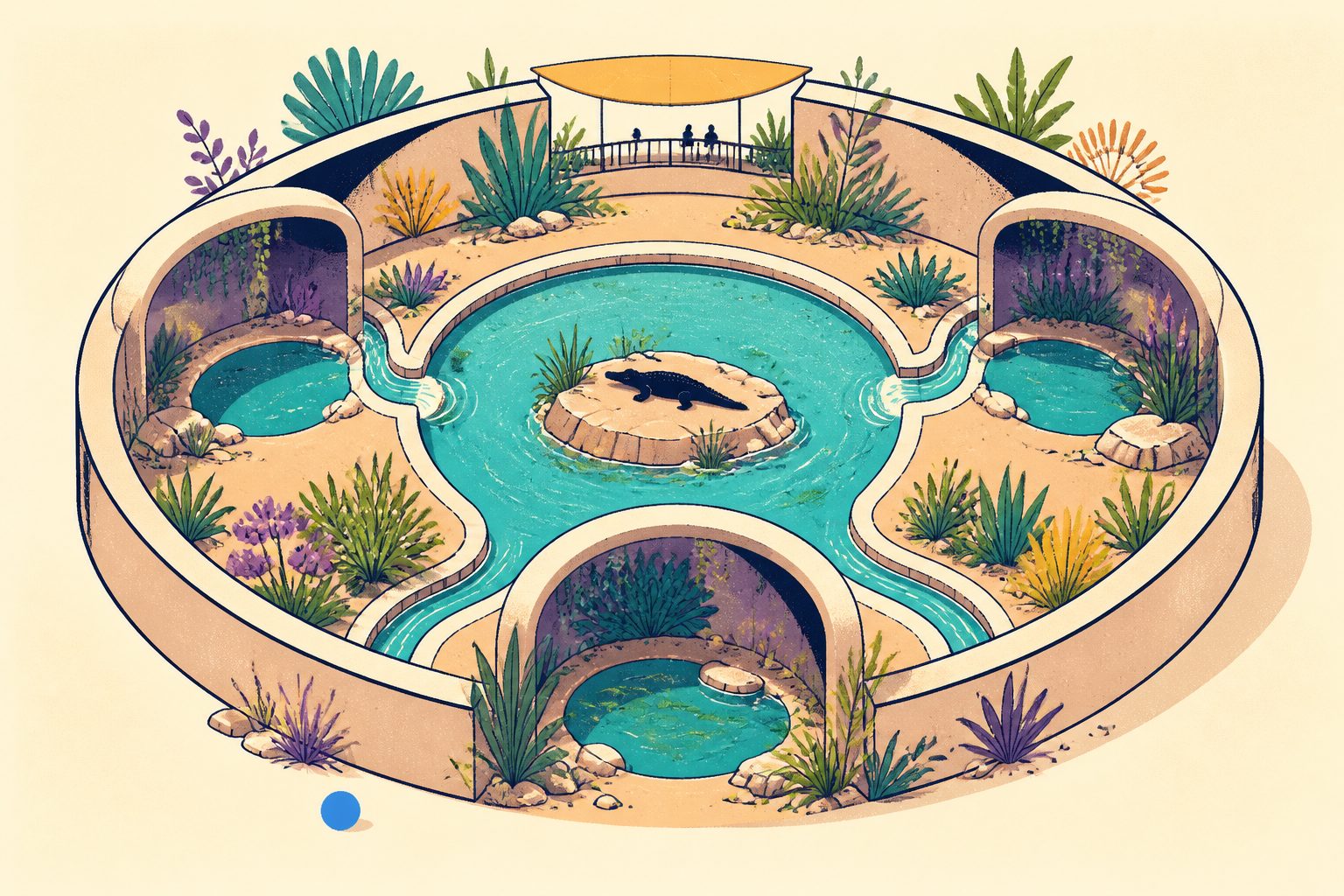
The water at the Crocoseum is clear. Clear water is the plot. The zoo says Steve Irwin wanted visitors to see crocodiles in clear pools so they could observe behavior that murkier water usually hides. A crocodile gets a stage there because visibility is the lesson: an animal famous for disappearing beneath the surface becomes, briefly, possible to study with your own eyes. Australia Zoo's Crocoseum page explains the design.
The blunt answer is that the show is entertainment and education. There is no virtue in pretending it is neither. The park calls the daily Wildlife Warriors Show a conservation experience, with crocodiles, birds and snakes in the same arena. What makes the format defensible is not the size of the crowd. The test is whether the crowd leaves with a more precise idea of what it has seen.
The useful lesson is visibility, not bravado
Crocodiles make a tidy educational subject because people arrive with a strong feeling about them already. The clear pool gives a presenter something specific to talk through: how an animal moves, waits and uses water. Robert Irwin's profile says he participates in daily crocodile demonstrations and uses them to share his knowledge of his favorite animal. That makes a better frame for the show than heroics. A public encounter should make the animal more legible, not make a human look fearless. Irwin's profile sets out that public role.
The small delight is almost comic: a creature that normally wins by being hard to see is put in a clear pool so people can notice it. A clear pool is not the same thing as understanding every crocodile in the wild. Instead, it offers a first invitation to trade a vague shiver for an actual question. Good animal education often begins there.
The show has a back room
A stage is also a piece of infrastructure. The Crocoseum uses a system of channels and gates connected to private habitats, allowing individual animals to be brought out, according to the zoo. Its Crocodile Environmental Park page describes another public learning space, Croc School, where guests can hear about conservation and research. The Crocoseum description and the environmental-park page describe the zoo's own version of that setup.
That matters because a wildlife presentation should not erase the care and planning outside the audience's view. It is reasonable to enjoy a live animal program and still ask how its habitat, handling and education claims are being supported. The grown-up pleasure of a place like this is curiosity with its shoes tied.
Research does not happen in the stadium
Its crocodile conservation program, run with the University of Queensland and Wildlife Warriors, uses tagging, acoustic telemetry, satellite transmitters, monitoring and samples to study wild crocodiles, according to the zoo. The University of Queensland separately reports that a decade-long study in the Steve Irwin Wildlife Reserve used implanted tracking devices and produced more than five million detections. Australia Zoo's project page describes the field methods, while UQ's account shows why the data work is its own discipline.
That division is healthy. A public show can create attention. Field researchers can test ideas about movements and behavior. Neither job becomes more impressive by pretending it is the other. The stage has a job. The study has another.
Keep the outdoor version outdoors
Nothing in a controlled presentation is a guide to approaching wildlife. Queensland's current Be Crocwise advice tells people in crocodile habitat to follow local safety guidance, keep out of the water and stay back from the water's edge. The government also stresses that crocodiles can be hard to see and highly mobile. Its Crocwise guidance is the relevant page for real-world behavior, not a video clip or an arena memory.
A show earns its spectacle when the question travels home
The zoo says its education officers draw on classroom and environmental-education experience, and that conservation informs its programs. The claim is worth measuring against the feeling a visitor carries away. Did the show make someone ask where an animal lives, how research works, or how people share an ecosystem with it? If so, the crocodile was not merely the loudest part of the afternoon. Australia Zoo's education page lays out that stated goal.
The ideal souvenir is not a dramatic story about being close to a crocodile. It is a little more respect for the fact that the animal has a life beyond the clear pool. That is a modest ambition for a stadium, and a surprisingly good one.
Sources
Every factual claim above traces to one of these. Links open in a new tab.