El Niño vs. La Niña: Which One Brings More Snow

Neither phase makes the whole country snowier. The answer flips depending on your latitude, and a skier in the Sierra is hoping for the opposite of a skier in the northern Rockies.

Ask a skier in Mammoth, California, and a skier in the northern Rockies which Pacific phase they are hoping for this winter, and you will get two opposite answers. I checked the same maps they check, and the split is real. El Niño and La Niña are two ends of one Pacific cycle, and each one simply aims the snow at a different half of the country.
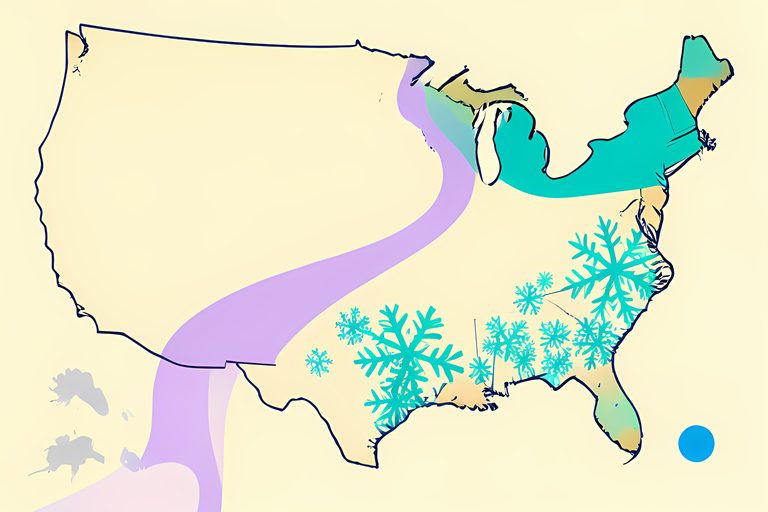
The setup is mirror-image simple. El Niño is the warm phase: the subtropical jet stream strengthens and drops south, which makes the southern tier wetter while the northern tier runs drier and warmer. La Niña is the cool phase, and it flips the script. The jet stream rides north, so the Pacific Northwest and the northern tier turn colder and wetter, while the South dries out. The National Weather Service describes the two phases almost as before-and-after photographs of each other.
Two phases, two different winners
- El Niño favors the southern half: California's Central Sierra, the Wasatch in Utah, the high country of Arizona and New Mexico, and the southern Colorado ranges around Wolf Creek.
- La Niña favors the northern tier: the Cascades in Washington and Oregon, the northern Rockies, and the northern Great Lakes.
The physics underneath is worth naming once, because it explains why the flip is so tidy. Warm water in the central Pacific strengthens the subtropical jet and bends it south, while cooler water there lets the polar jet dig farther south and take over the northern half of the country. Think of it as two different highways for storms, running through two different halves of the country, with the snow riding along as cargo on whichever road happens to be open.
None of this is a promise, and that is the part worth holding onto. I keep coming back to the word tilt, because it is the honest one. The Climate Prediction Center analyzed snow seasons from 1950 through 2009 and found that El Niño only tilts the odds, the way a weighted coin does. Some strong El Niño winters still flop in the places that should win. But the tilt itself is consistent enough that forecasters lean on it every autumn when they sketch the season.
The southern storm track is the consistent signal. A strong El Niño tends to push that track harder, which favors the Sierra and the southern Rockies, while the Pacific Northwest and the northern tier usually draw the short end of a warmer, drier winter. Utah sits near the boundary between the wetter south and the drier north, which is why forecasters keep calling it the wild card. That line in the sand is real, and it decides whether your roof or your neighbor's roof is the one that needs the shovel.
The part I genuinely enjoy
Here is what I find fun about the whole question. Which one brings more snow has no single answer, and that is exactly what makes it a good question. Your snow is someone else's dry spell. A heavy winter in Flagstaff is the other side of a thin snowpack near Seattle. We are all watching the same stretch of ocean, cheering for opposite outcomes, and the ocean does not take sides.
So if you are planning a ski trip or just wondering whether the sleds come out this year, start with your latitude. South of roughly a line through the middle of the country, you are rooting for this El Niño to hold. North of it, you are rooting for the forecast to wobble. Neither side is wrong. They are just standing in different weather.
Sources
Every factual claim above traces to one of these. Links open in a new tab.