Chuseok Traditions and Harvest Holiday Guide
From ancient Silla weaving contests to fragrant pine-steamed songpyeon, explore how Korea celebrates its grand autumn harvest festival.
When the eighth lunar month arrives, an unmistakable warmth settles over Korean neighborhoods. I love tracking how ancient seasonal rhythms still organize modern life, and few moments capture that spirit as vividly as Chuseok. Also known as Hangawi, this three-day autumn celebration marks the harvest full moon with a blend of reverence, homecoming, and table-filling abundance. While international travelers often hear it described as Korean Thanksgiving, that shorthand captures only a fraction of its cultural depth.
We find that the holiday is less about a single feast and more about an enduring cultural pact between generations. Families crisscross the peninsula to reunite in ancestral hometowns, steam fragrant batches of half-moon rice cakes over forest pine needles, and lay out meticulously arranged morning memorial tables. It is an occasion where ancient folklore, agrarian gratitude, and contemporary family life meet under the brightest moonlight of the year.
The Silla Kingdom Roots of Hangawi
The cultural lineage of Chuseok stretches back two millennia into the Korean Three Kingdoms period. According to the 12th-century historical chronicle Samguk Sagi (Records of the Three Kingdoms), the festival originated as Gabae during the reign of King Yuri, the third monarch of the ancient Silla Kingdom. King Yuri organized the women of the capital into two competing teams led by royal princesses, tasking them with weaving hemp cloth over the course of a full month from the sixteenth day of the seventh lunar month.
When the fifteenth day of the eighth lunar month dawned, the judges weighed the finished bolts of cloth. The losing team was obligated to host the victors with an elaborate feast of food, rice wine, and communal songs known as Hoeso. This festive gathering laid the structural foundation for what Koreans have celebrated for centuries as Hangawi. The native word combines han, meaning grand or great, with gawi, an archaic term for the middle of autumn.
That celebratory spirit survives in one of Korea's most cherished proverbs: Deodo malgo, deoldo malgo, hangawiman gat-ara ('May your days be neither more nor less, just like Hangawi'). In our editorial reading of traditional Korean literature, this phrase stands out as a timeless wish that ordinary daily life might always mirror the fullness, peace, and shared joy of the autumn harvest.
Gwiseong and the Great Homecoming
In the modern era, the celebration begins not at the dinner table, but on expressways, train platforms, and airport terminals. Millions of people living in metropolitan Seoul and regional hubs travel to their ancestral hometowns in a massive annual movement known as Gwiseong (the homecoming). High-speed KTX train tickets sell out within minutes of release weeks in advance, and families pack cars with gift sets of premium Hanwoo beef, seasonal Korean pears, and artisanal wild honey.
I find this collective pilgrimage remarkable because it transforms quiet rural villages into bustling family crossroads. In an age where urban hustle often separates extended families, Chuseok creates a shared national pause. The roads may crawl with traffic, but the journey culminates in multi-generational kitchens alive with laughter, peeling chestnuts, and the hiss of steamers.
The Ritual Morning: Charye and Seongmyo
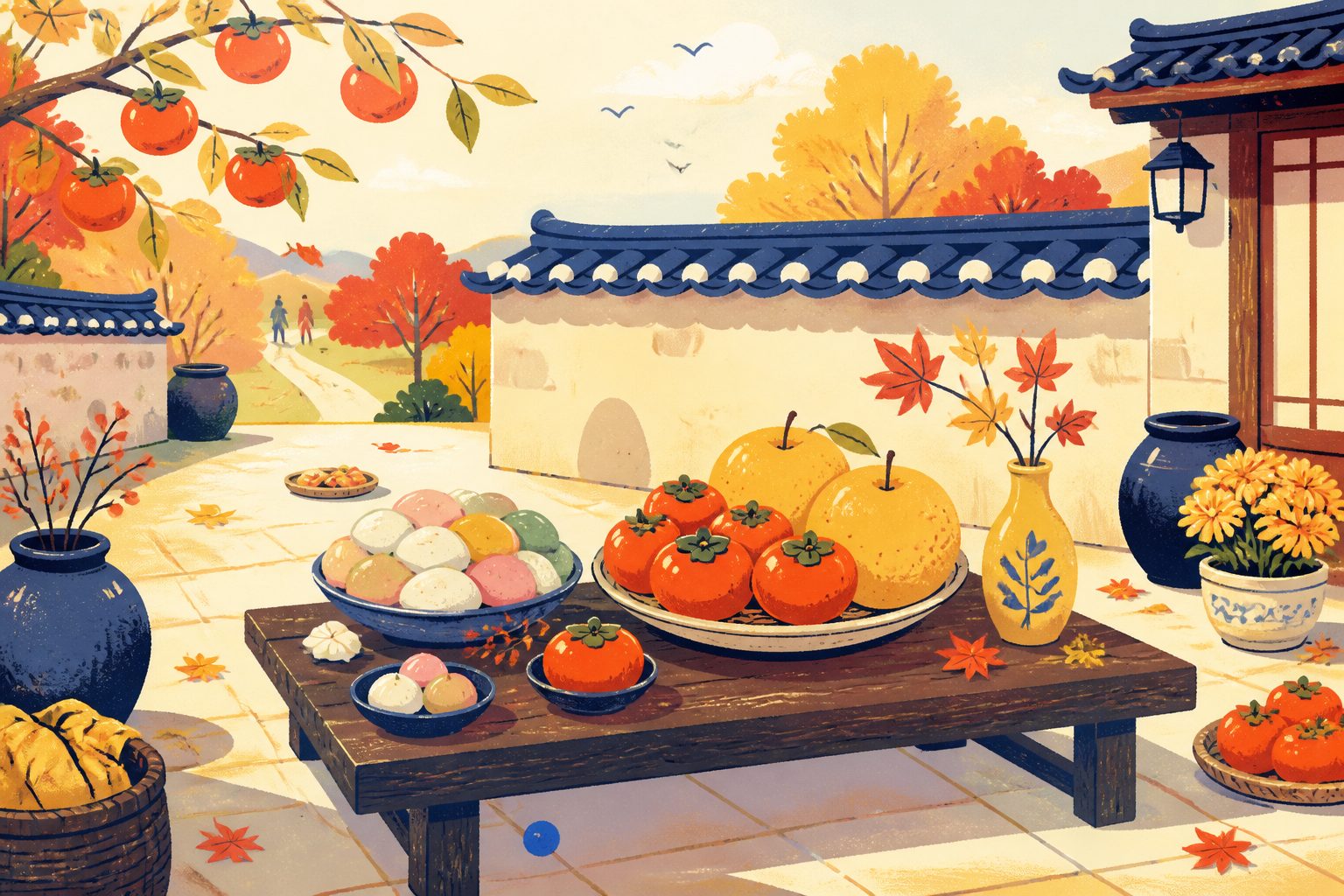
The formal heart of Chuseok takes place on the holiday morning through the ancestral memorial ceremony known as Charye. Families gather before a ceremonial table laden with newly harvested grains, freshly picked jujubes, Asian pears, persimmons, savory jeon pancakes, and freshly brewed rice wine. Unlike the somber memorial rites held on death anniversaries, Charye is a vibrant act of thanksgiving, offering the season's first agricultural fruits to preceding generations in gratitude for their blessings.
| Chuseok Element | Traditional Practice | Cultural Meaning |
|---|---|---|
| Charye | Morning ancestral food offering | Gratitude for the autumn harvest and ancestral protection |
| Seongmyo & Beolcho | Visiting and weeding ancestral burial mounds | Filial duty and seasonal caretaking of family resting places |
| Songpyeon | Pine-steamed half-moon rice cakes | Wishes for future growth, prosperity, and family health |
| Ganggangsullae | Moonlit circle dance with call-and-response song | Community unity, feminine solidarity, and fruitful harvest prayers |
| Ssireum | Traditional sand-pit folk wrestling | Celebration of strength, agricultural vigor, and holiday amusement |
After the ceremonial bows and the communal sharing of the blessed food (Eumbok), families embark on Seongmyo, visiting the grave sites of their ancestors. Weeks before Chuseok, relatives often participate in Beolcho, the dedicated ritual of clearing late-summer weeds and tidying the grassy earthen burial mounds. Standing together on sunlit hillsides, family members pay their respects, pour a small cup of rice wine over the soil, and reaffirm the ties that bind living descendants to their family history.
Songpyeon: The Crescent Moon at the Center
No Chuseok table is complete without Songpyeon, the half-moon rice cakes that define the holiday palate. Made from non-glutinous rice flour dough colored naturally with mugwort, kabocha pumpkin, dried gardenia seeds, or purple sweet potato, each palm-sized pouch is stuffed with sweet fillings. Roasted sesame seeds blended with honey, sweetened red beans, crushed chestnuts, and nutty mung beans provide a satisfying textural contrast to the chewy wrapper.
Across the Korean provinces, distinct regional interpretations have flourished for generations. In mountainous Gangwon Province, cooks prepare potato songpyeon shaped into rustic hand-pressed crescents. In coastal Jeolla, artistic flower songpyeon feature delicate tinted dough petals layered onto the outer skin. In Jeju, pea-filled dumplings take on unique round saucer profiles.
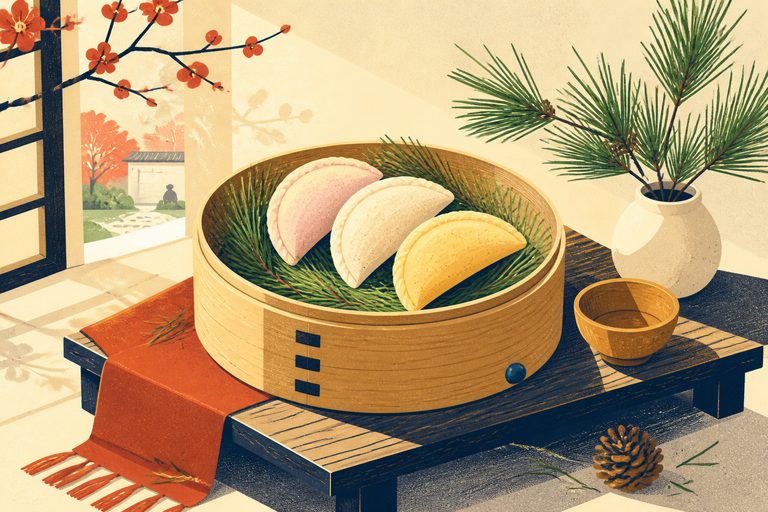
What makes every style special is the steaming method: the cakes rest on a thick bed of freshly gathered pine needles (solip). As steam rises through the pot, the needles infuse the rice skin with a refreshing woody aroma while preventing the sticky pieces from clinging together. Korean folklore playfully adds that anyone who molds neatly shaped songpyeon will be blessed with a beautiful daughter or find a wonderful partner.
Ganggangsullae and the Magic of the Harvest Moon
As twilight falls on Chuseok evening, communities look to the clear autumn sky. Under the brilliant glow of the harvest full moon, women historically gathered in open courtyards to perform Ganggangsullae, a traditional circle dance recognized by UNESCO as Intangible Cultural Heritage of Humanity. Joining hands in a grand ring, the dancers rotate gracefully while a lead singer improvises verses and the circle answers with a joyful chorus.
The dance begins with a slow, stately tempo and accelerates into a spinning celebration of rhythm and communal joy. Legend holds that during the 16th-century Imjin War, Admiral Yi Sun-sin had local women dance around fires on coastal hills to deceive enemy warships into believing a massive army stood guard. Today, whether through lively folk dances, traditional Ssireum sand-pit wrestling bouts, or quiet moon-gazing walks, our modern world still finds inspiration in Chuseok's enduring message of light, gratitude, and belonging.
Sources
Every factual claim above traces to one of these. Links open in a new tab.