The Pine Needle Secret Behind Fragrant Chuseok Songpyeon

Unpack the ancient science, forest aroma, and historical half-moon symbolism that turn pine needles into songpyeon's essential partner.
Every autumn kitchen preparing for Chuseok carries a scent you never forget once you have encountered it. Alongside the nutty sweetness of roasted sesame seeds and simmering chestnuts, a sharp, clean evergreen fragrance fills the air. I always appreciate how culinary traditions preserve ingenious practical science, and songpyeon is one of the most delightful examples in East Asian cooking.
The name itself reveals the central secret. The Korean prefix song (송) comes directly from sonamu (소나무), meaning pine tree, while pyeon refers to a steamed rice cake. Without fresh pine needles (solip), a batch of songpyeon is simply not complete. Far from being a mere decorative flourish, those slender green needles perform three vital culinary and biochemical jobs in every traditional steamer. We can see how ancient Korean cooks solved real preservation challenges with forest botany.
Natural Phytoncides: Ancient Food Preservation
Long before modern electric refrigeration existed, autumn in Korea presented a distinct food safety challenge. Late September often brings warm, humid afternoons where freshly steamed rice dough can quickly spoil or harbor mold. Korean ancestors solved this through botanical chemistry.
Pine needles naturally produce high concentrations of phytoncides, volatile organic compounds including alpha-pinene, beta-pinene, and monoterpenes that conifers secrete to defend themselves against harmful insects and fungal pathogens. When subjected to hot cooking steam, these compounds infuse the surrounding environment, acting as an organic antimicrobial shield. Steaming songpyeon over a dense bed of pine needles actively inhibits bacterial growth, allowing the delicate rice cakes to remain fresh and safe to eat over several days of holiday travel and family visits.
The Non-Stick Steamer Bed and Needle Selection
Beyond microbiology, pine needles serve a purely practical structural purpose in the kitchen. Traditional songpyeon are made with non-glutinous short-grain rice flour (mepssal-garu), kneaded with hot water into a silky, supple dough. When steamed in earthenware steamers (siru) or bamboo baskets, the starch gelatinizes and becomes intensely tacky.
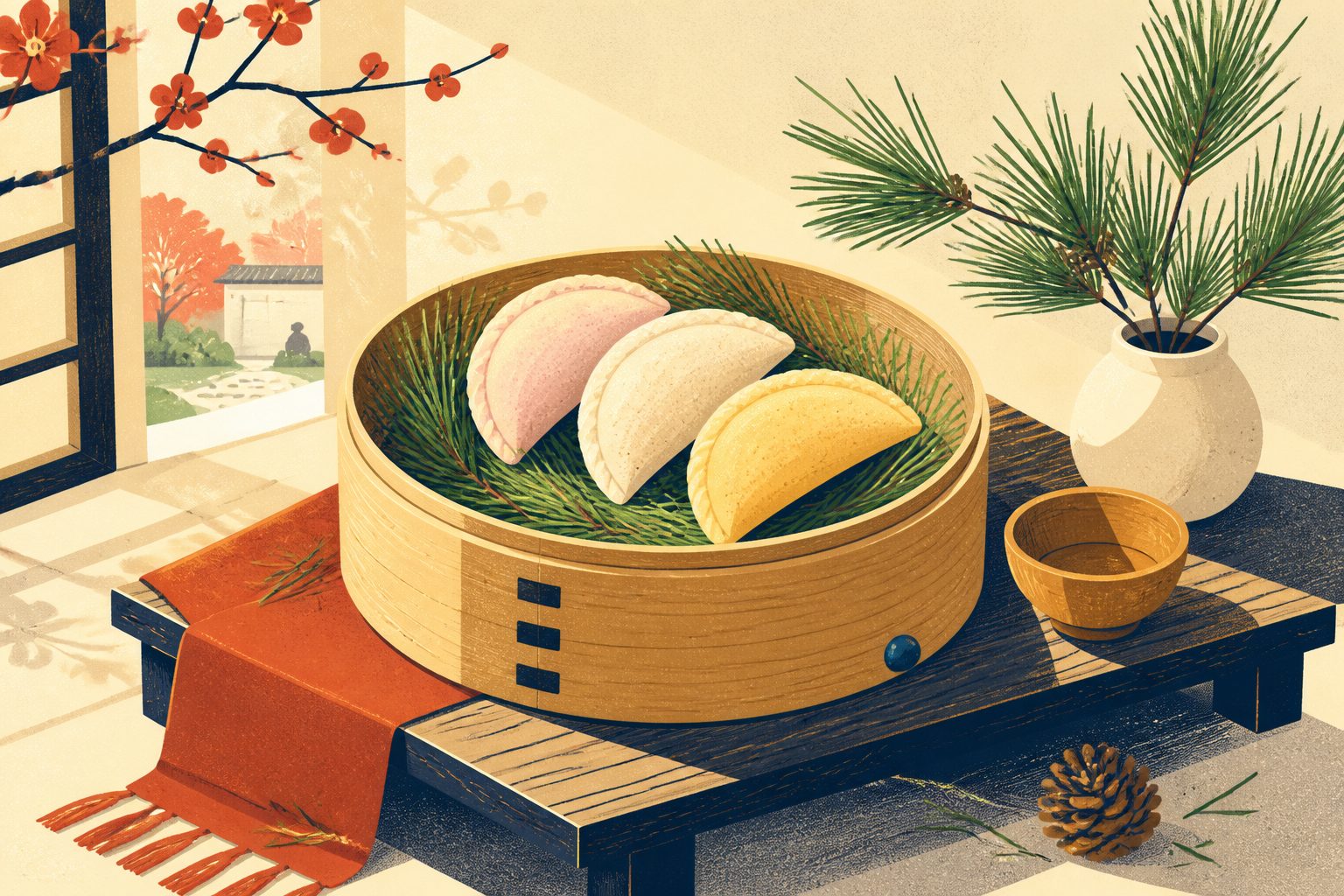
Laying a thick, crisscrossed cushion of washed pine needles across the bottom of the steamer creates a natural non-stick barrier. It keeps the delicate dumplings elevated above pooling moisture while preventing them from sticking to the steamer or tearing into neighboring cakes. When lifted out, each songpyeon carries subtle, rustic needle imprints embossed diagonally across its glossy skin.
Cooks traditionally prefer needles from Korean red pine trees (Pinus densiflora, known locally as jeoksong or somok). These needles are gathered from clean mountain slopes in early autumn, thoroughly washed in cold water, trimmed of their woody end sheaths, and dried before use. Their soft structure and rich aromatic resin provide the ideal balance of perfume and cooking performance without imparting any bitter flavor to the delicate dough.
In our exploration of traditional recipes, this preparation shows remarkable patience. Families often make dough in four or five vibrant hues using mugwort, kabocha squash, and purple sweet potato. Arranging these colorful dumplings across a deep green pine bed creates a visual feast before the steamer lid even closes.
The Half-Moon Prophecy and Ever-Growing Prosperity
While Chuseok takes place beneath the brilliance of a harvest full moon, songpyeon are intentionally shaped as crescents. An ancient legend recorded in Korean historical lore traces this custom to the 7th-century Three Kingdoms era during the reign of King Uija of Baekje.
Baekje is like a full moon, and Silla is like a half moon.
When an enigmatic turtle emerged bearing those carved words, the royal diviner explained the ominous meaning: a full moon has reached its peak and must inevitably wane, whereas a half-moon holds the promise of growing larger each passing night. Silla embraced the crescent as a symbol of rising fortune and ultimate unification.
Today, molding dough into a half-moon serves as an enduring wish that a family's prosperity, health, and happiness will continue to expand in the season ahead. I find this harmony of kitchen chemistry and optimistic folklore deeply satisfying: the humble pine needle protects the rice cake while the crescent shape promises a brighter tomorrow.
Sources
Every factual claim above traces to one of these. Links open in a new tab.