3 Limits That Keep a Delivery Drone Focused on Small Packages

The five-pound limit is only the visible part of the answer. A drone delivery needs a suitable item, a reachable address and conditions that leave room for a cautious flight.

Aerial delivery sounds as if it should make every online order lighter than air. I find the opposite detail more revealing: the service becomes plausible by being choosy. The modern delivery drone is not a flying replacement for every van. It is a small, highly managed trip for the things that fit its compartment, its route and its landing routine.
Amazon's current Prime Air rules are a useful case study, not a universal rulebook for every delivery company. The company says nearly all items five pounds or less that fit in a large shoebox are eligible where its service is offered. That sounds like one limit. In practice, it is three separate filters working together.
1. The parcel has to fit the aircraft's modest job
Weight is the headline because it is easy to remember. Shape matters just as much. Amazon describes its eligible Prime Air items as five pounds or less and able to fit in a large shoebox. Its U.K. description of the MK30 likewise says the package rides in a compartment on the underside of the aircraft. A bag of dog food, a floor lamp or an awkwardly wide box cannot be wished into that geometry by faster motors.
The cheerful consequence is that the most drone-shaped orders are pleasingly unglamorous: batteries, a phone accessory, sunscreen, a small grocery item. The aircraft is not trying to win a strength contest. It is built for a short errand where the item is already compact enough to travel without turning the flight into a physics lecture.
2. The address has to be a usable destination, not just a point on a map
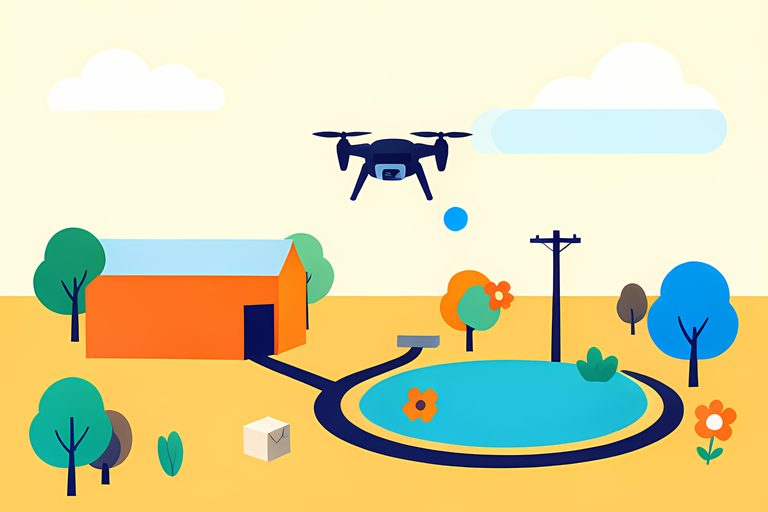
A qualifying item still needs a qualifying destination. Amazon says availability can vary within a service ZIP code, and customers select a preferred delivery point. Its service pages describe digital maps that identify candidate zones and a later check that the spot is clear of people, pets and vehicles. A pool can look like a tidy rectangle from above but is plainly not a place to put down a parcel. That tiny cartographic joke is also a serious operational distinction.
This is why a delivery radius is better read as a possibility than a promise. At the Westborough community meeting reported by Spectrum News on September 24, 2026, Amazon described a separate property-clearance check even for customers inside the proposed radius. We should resist turning a circle on a promotional map into a guarantee for every house inside it.
3. The conditions have to let the whole trip stay cautious
The item and address can be perfect while the flight is not. Amazon says its system may not offer drone delivery when weather conditions are unsuitable, even though its MK30 is designed to operate in light rain. The company describes a 75-minute forward-looking weather check for the next hour of delivery. The FAA, meanwhile, describes commercial package delivery as an aviation operation requiring operator certification, airspace authorization and environmental compliance.
That pairing explains the limit better than a simple weight label. A small package keeps the aircraft within a known operating profile; a clear destination makes the last moments manageable; appropriate conditions keep the route from becoming a dare. I like that the system's most sensible answer can be a quiet no for now, followed by ordinary ground delivery instead. Reliability is not the same as insisting every order fly.
| Filter | What it asks | Why it matters |
|---|---|---|
| Parcel | Is it within the service's stated weight and size limits? | The aircraft needs a secure, predictable load. |
| Place | Is there an eligible, clear delivery point at this address? | A street address alone does not create a safe drop-off zone. |
| Moment | Do weather and operating conditions permit the flight? | The safest service is allowed to decline a trip. |
I would not use the five-pound number as a prediction that every drone service will forever share it. Aircraft, rules and operating models differ. It is, however, a useful clue to the present logic: tiny cargo makes it easier to keep the route, the landing point and the customer's expectation pleasantly straightforward.
Sources
Every factual claim above traces to one of these. Links open in a new tab.
- Amazon Prime Air drone delivery is expanding to nearly 500 US cities and towns this year
- Inside Amazon's first UK drone delivery site for Prime Air
- Amazon's drones deliver items in 60 minutes or less
- Package Delivery by Drone (Part 135)
- Finding of No Significant Impact and Record of Decision for Drone Package Delivery in Texas
- In front of overflow crowd Amazon detailed proposed drone delivery program for Westborough